Compact Forklift Benefits for Small Warehouses and Restricted Work Areas
Key Takeaways
- Maintenance standards
- Safe operation
- Field inspection guidelines
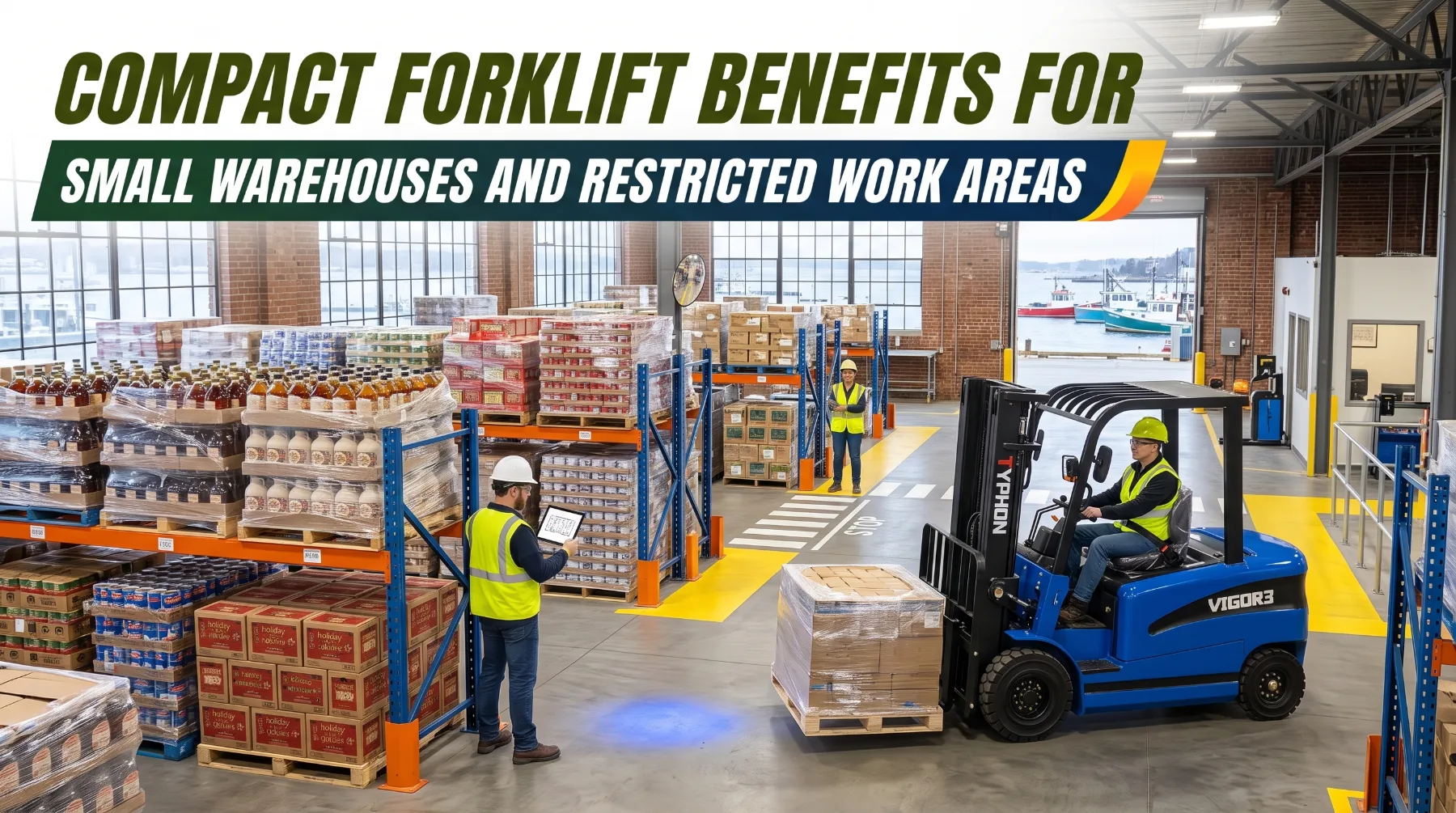
Small warehouses and restricted work areas often face challenges that larger facilities can avoid. Narrow aisles, closely spaced storage racks, limited loading zones, and frequent changes in inventory can make material handling difficult. When space is limited, moving pallets efficiently requires equipment that can navigate the available floor area without compromising operator visibility or workplace safety. Compact forklifts offer a practical option for businesses that need to transport, lift, and position materials in confined environments.
Their smaller dimensions can help operators work in areas where larger forklifts may have difficulty turning or accessing storage locations. However, a compact design does not automatically make a forklift suitable for every warehouse. Load weight, lifting height, turning radius, aisle clearance, floor conditions, and operating frequency all influence equipment selection. Understanding these factors allows warehouse managers to identify where compact forklifts can improve daily operations and where additional planning is necessary.
Matching Capacity to Warehouse Loads
Compact forklifts can handle a variety of warehouse materials, but their lifting capacity must match the actual loads being transported. Businesses should identify the heaviest expected pallet, the typical weight of stored goods, and any unusual load dimensions before choosing a machine. Selecting equipment based only on average pallet weight can create problems when heavier shipments arrive or inventory changes.
The rated capacity of a forklift depends on more than the total weight of the material. Load center, lifting height, mast configuration, and attachment type can influence how much weight the machine can safely lift. A long or unevenly distributed load may place its center of gravity farther forward than a standard pallet, reducing the forklift's available lifting capacity. Attachments such as clamps or specialized handling equipment can also affect the approved capacity.
Warehouse operators should check the forklift's capacity plate and consult the manufacturer's specifications for the intended operating configuration. The load must remain within the machine's rated limits throughout lifting, traveling, and placement. If the capacity plate does not clearly cover a particular attachment or load arrangement, the operator should obtain the appropriate capacity information before proceeding.
Capacity planning should also consider how materials are handled at different elevations. A forklift that can safely lift a particular load at a low height may have a lower allowable capacity when the load is raised to a higher storage level. Warehouse managers should verify the required lifting height, mast specifications, and load capacity together. Choosing a forklift with an appropriate capacity margin for the expected workload can provide greater flexibility without encouraging operators to exceed its limits.
Maneuverability in Narrow Aisles
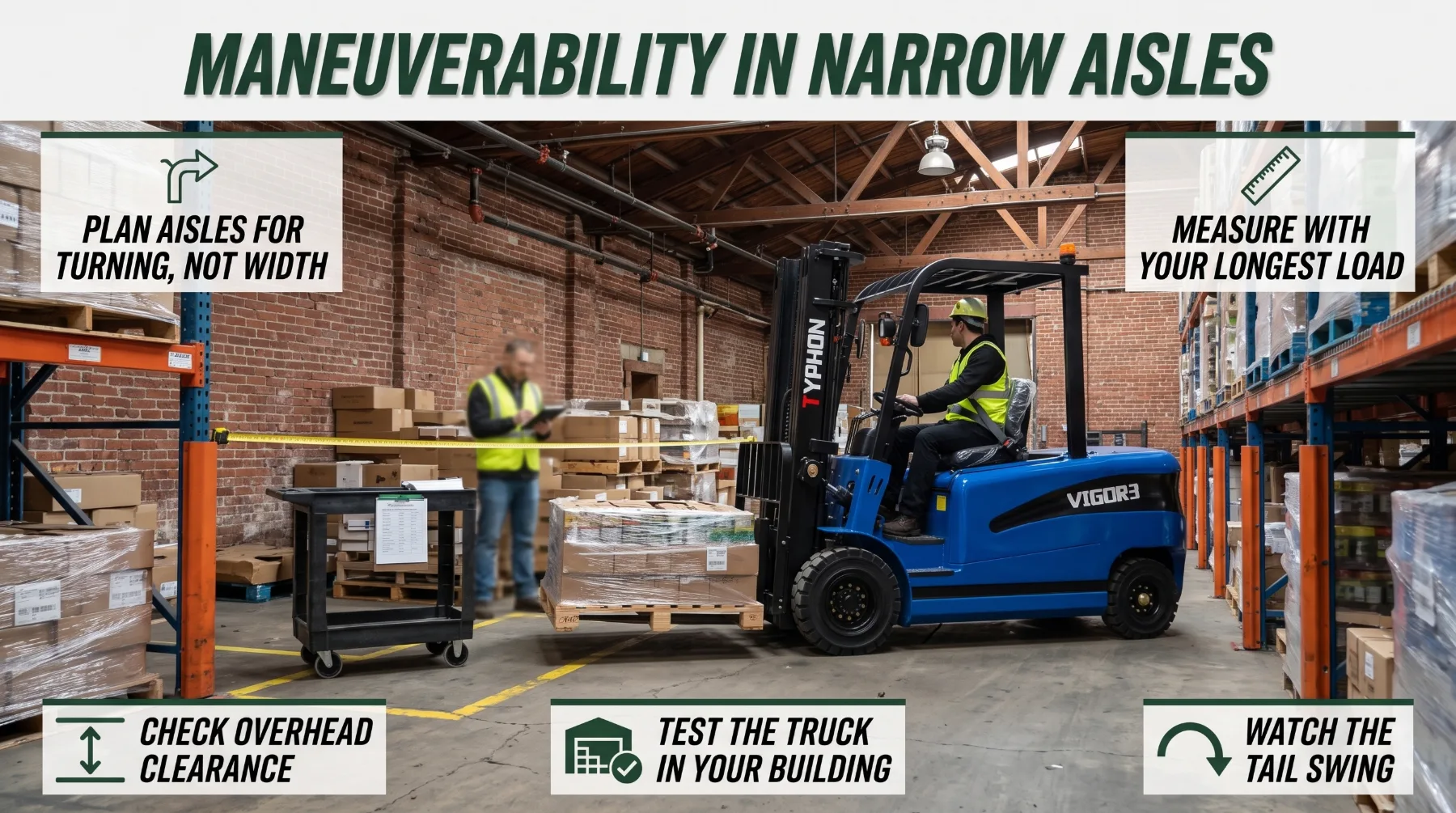
Compact forklifts are designed to operate in work areas where overall machine dimensions and turning requirements are important. Their smaller chassis can make it easier to navigate between storage racks, approach pallet positions, and move through restricted warehouse spaces. This can be particularly valuable in older buildings or facilities where aisle widths were established before modern material handling equipment was introduced.
Improved maneuverability can also help operators position loads more accurately during routine warehouse tasks. When placing pallets near shelving, loading delivery vehicles, or moving supplies around fixed obstacles, a forklift that fits the available space can reduce the need for repeated repositioning. Fewer unnecessary movements may help maintain a more organized workflow, provided operators have enough room to complete each maneuver safely.
Nevertheless, warehouse aisles should never be planned around the forklift's dimensions alone. The space required for a turn depends on the machine's turning radius, the length and width of the load, fork dimensions, and the direction of travel. Operators also need sufficient clearance to avoid striking racks, walls, equipment, or nearby workers. A compact forklift should only enter an aisle when its actual operating requirements can be met.
Before purchasing equipment, warehouse managers should evaluate the narrowest travel routes and the most difficult pallet positions. Manufacturer specifications and practical layout assessments can help determine whether the forklift can enter, turn, and exit without excessive maneuvering. If the space is too restricted, changing the storage arrangement or selecting a different material handling solution may be safer than relying on a smaller machine.
Improving Storage and Material Flow
Compact forklifts can support warehouse layouts that make better use of available floor space. Their smaller dimensions may allow storage areas, pallet positions, and travel routes to be arranged more efficiently than layouts designed around larger machines. This can help businesses manage inventory in buildings where expanding the physical footprint is not practical.
Better equipment fit can also reduce unnecessary travel during common material handling tasks. When pallets are stored in accessible locations and delivery areas are organized, operators may spend less time moving materials between distant staging points. A well-planned layout can improve the flow of incoming shipments, stored inventory, and outgoing orders while reducing congestion around busy work areas.
However, increasing storage density should not come at the expense of safe forklift operation. Aisles must provide enough room for the forklift and its load to turn, travel, and stop safely. Emergency exits, fire equipment, pedestrian routes, and loading areas must remain accessible. Storing additional pallets in a previously open area can create hazards if it obstructs visibility or reduces necessary operating clearance.
Warehouse managers should evaluate the entire material handling process before changing storage arrangements. Reviewing delivery schedules, pallet sizes, picking frequency, and travel distances can reveal where compact forklifts offer practical advantages. Clear travel routes, consistent pallet placement, and designated staging areas help the equipment contribute to an organized warehouse rather than simply creating more storage space.
Floor Conditions and Indoor Operation
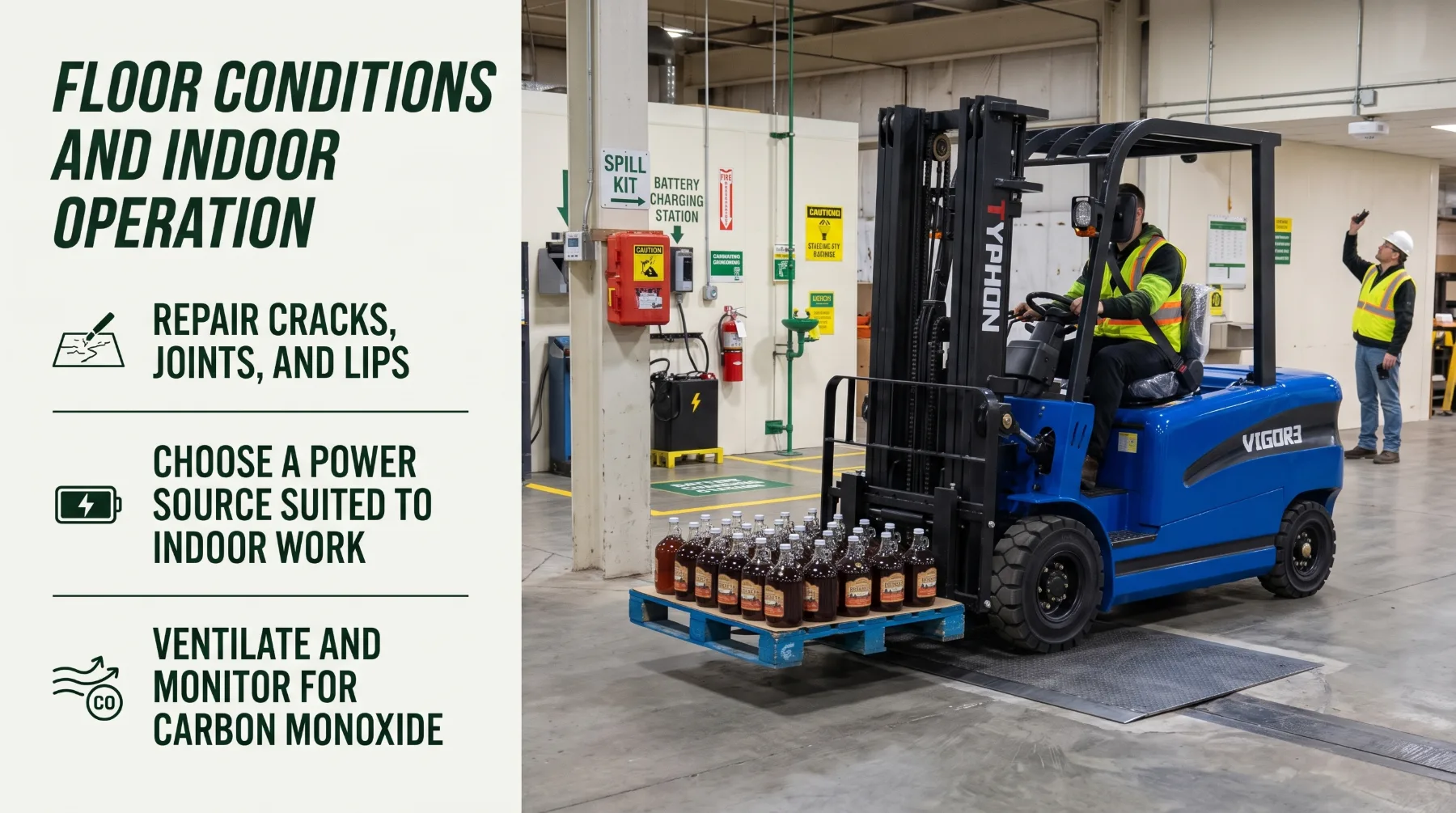
Warehouse floor conditions directly affect forklift stability, traction, and handling. Compact forklifts may operate in smaller spaces, but they still require a suitable surface that can support the machine, its load, and the forces created during movement. Concrete floors should be assessed for load-bearing capacity, particularly in older buildings, mezzanines, and areas with concentrated loading.
Cracks, uneven joints, loose debris, and damaged floor sections can interfere with wheel movement and affect the stability of transported materials. Slippery surfaces caused by water, oil, or other substances can reduce traction and increase stopping distances. Operators should inspect travel routes and report damaged or contaminated areas before continuing work through them.
The forklift's wheel configuration and power source should also match the workplace. Tire material, wheel size, and ground clearance can influence performance on different floor surfaces. Some compact forklifts are intended primarily for smooth indoor floors, while other models may be suitable for more demanding surfaces within their approved operating limits. Warehouse managers should confirm the manufacturer's recommendations rather than assuming that every compact model can handle uneven ground.
Indoor operation requires attention to ventilation and emissions as well. Electric forklifts can be suitable for enclosed areas where emissions from combustion engines would be a concern, although battery charging, electrical safety, and charging-space requirements must be considered. Internal combustion forklifts require appropriate ventilation and must comply with workplace restrictions for indoor use. Selecting the right power source helps support safe operation while accounting for operating hours, noise, charging access, and maintenance requirements.
Visibility and Pedestrian Safety
A compact forklift can be easier to position in restricted areas, but its smaller size does not eliminate blind spots. The mast, forks, load, and surrounding structures can obstruct the operator's view, especially when carrying tall or bulky materials. Operators should maintain a clear view of the travel path and avoid moving loads in ways that prevent them from seeing nearby obstacles or pedestrians.
When a load blocks forward visibility, operators should follow the manufacturer's guidance and workplace procedures for traveling in the appropriate direction. If visibility cannot be maintained, they should stop and use a suitable alternative, such as a trained spotter or a different route. Mirrors, cameras, and warning systems can support awareness, but they should not replace direct observation or safe operating practices.
Pedestrian separation is particularly important in small warehouses where workers may share limited space with forklifts. Marked walkways, barriers, designated crossing points, and controlled access can help reduce the chance of a collision. At corners, doorways, loading docks, and intersections, operators should slow down, use warning devices as required, and remain prepared to stop when visibility is restricted.
Warehouse managers should establish clear traffic rules for both operators and pedestrians. Workers need to understand where forklifts travel, where crossing is permitted, and how to communicate when approaching shared areas. A compact forklift should not be used to justify allowing pedestrians and powered equipment to operate in aisles that lack adequate separation or safe clearance.
Maintenance and Workplace Fit
Selecting a compact forklift requires more than comparing machine dimensions and lifting capacity. Warehouse managers should consider how the equipment will fit into daily operations, including operating hours, expected travel distances, storage heights, and the frequency of loading and unloading. A forklift that performs well during occasional pallet movement may not be suitable for continuous, high-volume material handling.
Service access and maintenance support should also influence the purchasing decision. Routine inspections need to cover brakes, steering, tires or wheels, forks, mast components, hydraulic systems, and warning devices. Damaged forks, worn tires, leaking hydraulic lines, or malfunctioning safety equipment can affect handling and lifting performance. Equipment should be removed from service when a defect makes continued operation unsafe.
Electric models require additional planning for battery charging, charging locations, and battery condition. Warehouse managers should confirm that the available charging infrastructure supports the expected workload and that charging areas meet the applicable safety requirements. For combustion-powered equipment, refueling arrangements, ventilation, and engine maintenance should be evaluated before the forklift is introduced into the facility.
Operator training and workplace procedures are equally important. Workers should receive training appropriate to the forklift they operate, including its controls, rated capacity, load handling, and limitations in restricted areas. Pre-shift inspections, clear reporting procedures, and scheduled maintenance help identify problems before they interrupt warehouse operations. The most suitable compact forklift is one that fits the actual workload, operating environment, and maintenance capabilities of the business.
Conclusion
Compact forklifts can improve maneuverability and material handling in small warehouses and restricted work areas. Their smaller dimensions may help operators access narrow storage aisles, position pallets more efficiently, and support organized material flow where larger equipment would be difficult to use. These benefits depend on selecting a forklift that matches the warehouse's actual layout and workload rather than choosing a machine based on size alone.
Safe and efficient operation requires suitable lifting capacity, adequate aisle clearance, stable floor conditions, good visibility, and effective pedestrian controls. Maintenance access, power source requirements, and operator training should also be considered before introducing the equipment. Careful planning and routine inspections help warehouse managers use compact forklifts effectively while maintaining safe working conditions.
Frequently Asked Questions
What is the main benefit of a compact forklift?
Its smaller dimensions and tighter turning radius can improve maneuverability in restricted spaces when the aisle and load requirements remain suitable. Those gains only hold when aisles are planned around the truck's real turning and stacking needs, and when its capacity covers your heaviest loads.
Can a compact forklift lift heavy warehouse loads?
Only within its rated capacity for the load center, attachment, and intended operating configuration. Capacity may drop at higher lift heights and with longer load centers. Confirm the true weight of your heaviest loads, and choose a truck that handles them at your highest rack level with margin.
Are compact forklifts suitable for indoor use?
They can be, provided the power source, ventilation, floor conditions, and workplace requirements are appropriate. Electric trucks produce no exhaust emissions and suit most indoor work. Propane trucks require good ventilation, engine maintenance, and CO monitoring. Floors must be strong and smooth enough for the truck, with cracks, joints, and lips repaired.
How should warehouse aisles be planned?
Allow for forklift dimensions, load size, turning space, stopping distance, and safe separation from pedestrians. Start with the manufacturer's right-angle stacking figure for your truck and longest regular load, then add a clearance margin. Test the layout with a demonstration before committing.