Load-Sensing Piston Pumps vs. Axial Piston Variable Pumps: Hydraulic Performance in TYPHON KUVUO Machinery
Key Takeaways
- Maintenance standards
- Safe operation
- Field inspection guidelines
An excavator's engine creates power, but the hydraulic pump decides how much of that power reaches the bucket. Two compact excavators with similar horsepower can feel completely different in the dirt. One holds its pace through a hard curl while lifting and swinging. The other bogs down, runs hot by mid-afternoon, and makes the operator move one function at a time. In most cases, the difference comes down to pump architecture.
This guide explains how pump design shapes real excavator performance. We cover fixed versus variable displacement, why piston pumps outperform gear pumps in demanding work, and how the two pump systems in TYPHON KUVUO machinery are engineered. The TYPHON KUVUO 4.0 Mini Excavator (SKU: TYPH-KUVUO) runs a load-sensing variable-displacement piston pump. The TYPHON KUVUO 2.7 Mini Excavator, KONSTRUCTZ Series (SKU: TYPH-KUVUO27) runs an axial piston variable pump. Both were chosen to deliver efficient, controllable power in their weight classes, and understanding how they work helps you get the most from every operating hour.
Fundamentals of Hydraulic Displacement in Compact Machinery
Fixed vs. Variable Displacement
Displacement is the volume of fluid a pump moves with each revolution of its input shaft. In a fixed-displacement pump, that volume never changes. At a given engine speed, the pump delivers the same flow whether the operator is digging hard, feathering a grade, or sitting idle with the controls in neutral. Any flow the circuit doesn't use must still go somewhere, so it passes back to tank through the control valve or across a relief valve. That bypassed flow carries energy that turns straight into heat.
A variable-displacement pump changes how much fluid it moves per revolution. When demand rises, displacement increases. When demand drops, displacement falls, and the pump stops pushing flow the machine doesn't need. The engine works less, the fluid stays cooler, and the operator gets power that tracks the job instead of fighting it.
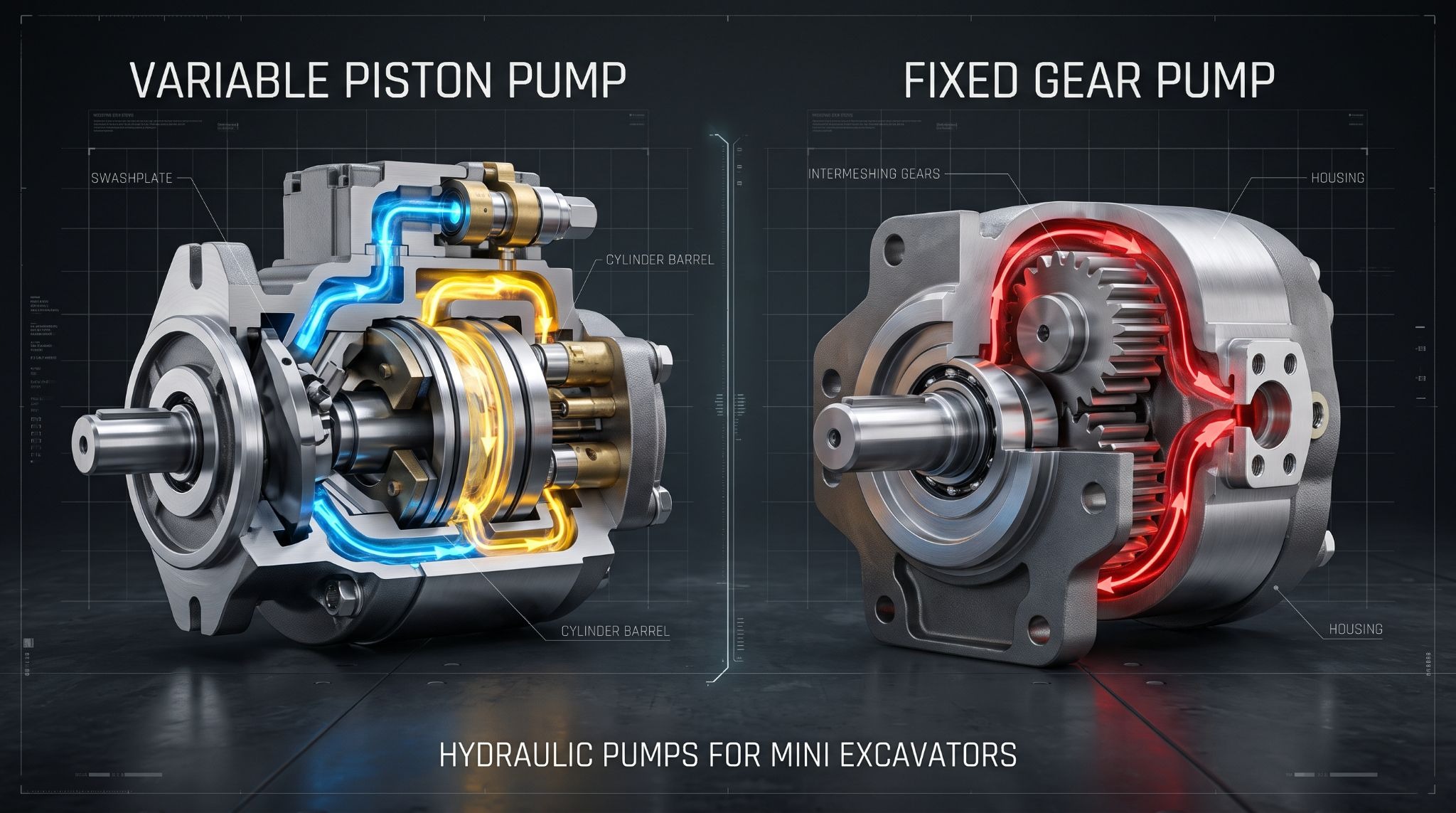
The mini excavator piston pump vs gear pump question comes down to efficiency, control, and service life. Gear pumps are simple and inexpensive. Two meshing gears carry fluid around the housing and push it into the outlet. Nearly all gear pumps used in compact equipment are fixed-displacement, and their internal clearances widen as they wear. As efficiency drops, the pump delivers less flow at working pressure and generates more heat doing it.
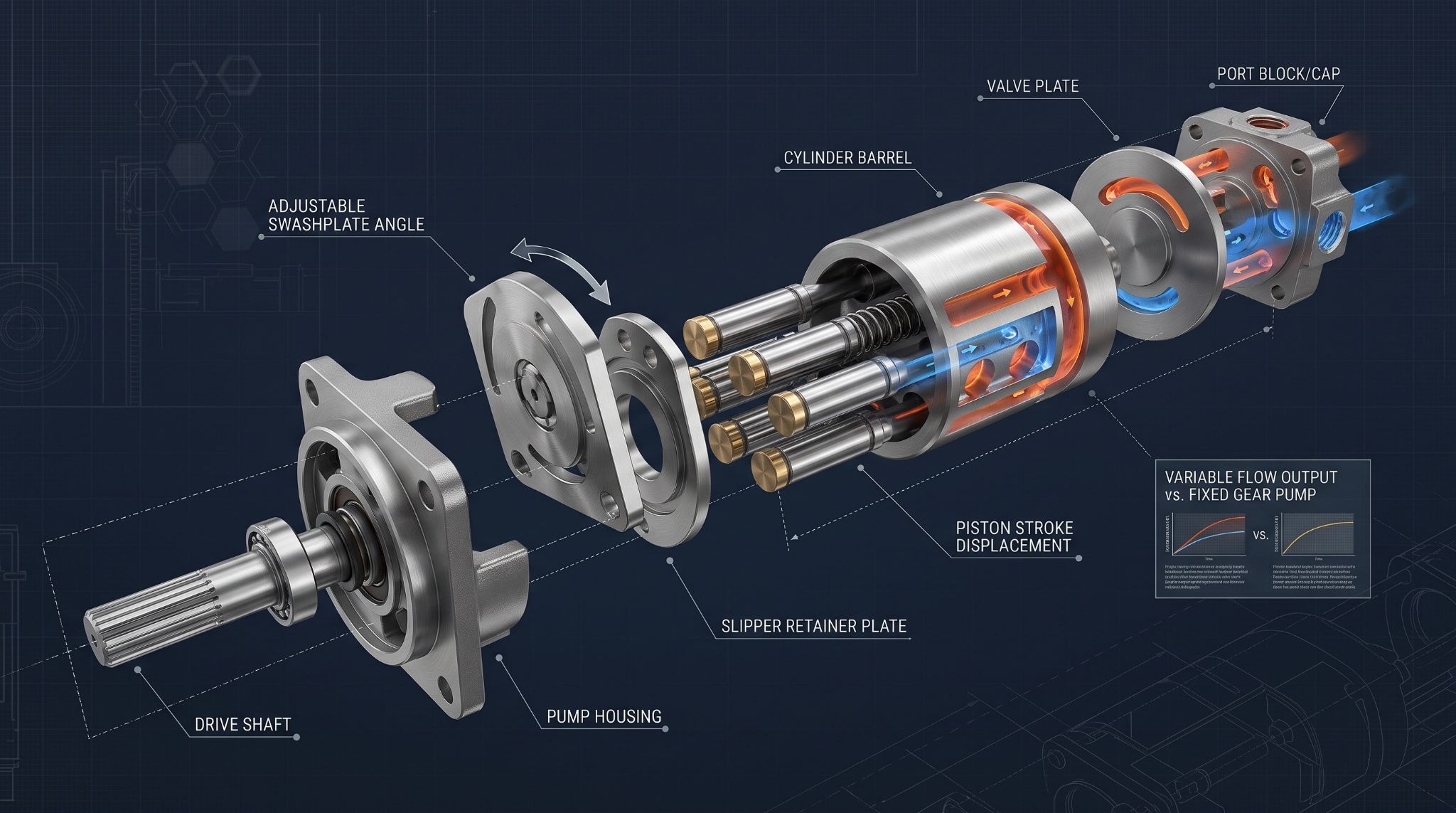
Piston pumps use a rotating cylinder block with pistons that stroke against an angled swashplate. Changing the swashplate angle changes piston stroke, which changes displacement. This design holds tighter tolerances, operates efficiently at high pressure, and allows displacement to be controlled precisely. For a hydraulic pump compact excavator application, where the machine constantly shifts between heavy breakout, fine grading, and multi-function movement, that control is the foundation of productive operation.
Why Pump Type Matters in Excavator Performance
An excavator rarely runs one function at a time. A normal dig cycle combines boom lift, stick pull, bucket curl, and swing, often while the operator repositions the tracks. The pump has to supply all of those circuits without starving any of them and without overloading the engine. A fixed gear pump handles this poorly because it cannot adjust to changing demand. A variable piston pump handles it well because adjustment is its core function. That is why TYPHON hydraulics are built on piston pump architecture across the KUVUO line.
Technical Spotlight: The 79.2 L/min Load-Sensing Piston Pump in the TYPHON KUVUO 4.0
How Load Sensing Works
The TYPHON KUVUO 4.0 uses a variable-displacement piston pump with a load-sensing system rated at 79.2 L/min (approximately 20.9 GPM), paired with a multi-way valve and an integrated hydraulic oil cooler. A load-sensing system adds a feedback loop on top of variable displacement. A signal line carries the highest working pressure from any active circuit back to the pump's control valve. The pump then sets its output to hold a small, fixed pressure margin above that load.
In practical terms, the pump always knows what the hardest-working function needs and supplies just enough pressure and flow to meet it. When the operator eases off the controls, the load signal falls, and the pump destrokes. When the bucket hits compacted clay, the signal rises, and the pump responds immediately. This is what defines a true load-sensing hydraulic excavator: output matched to the actual work, moment by moment.
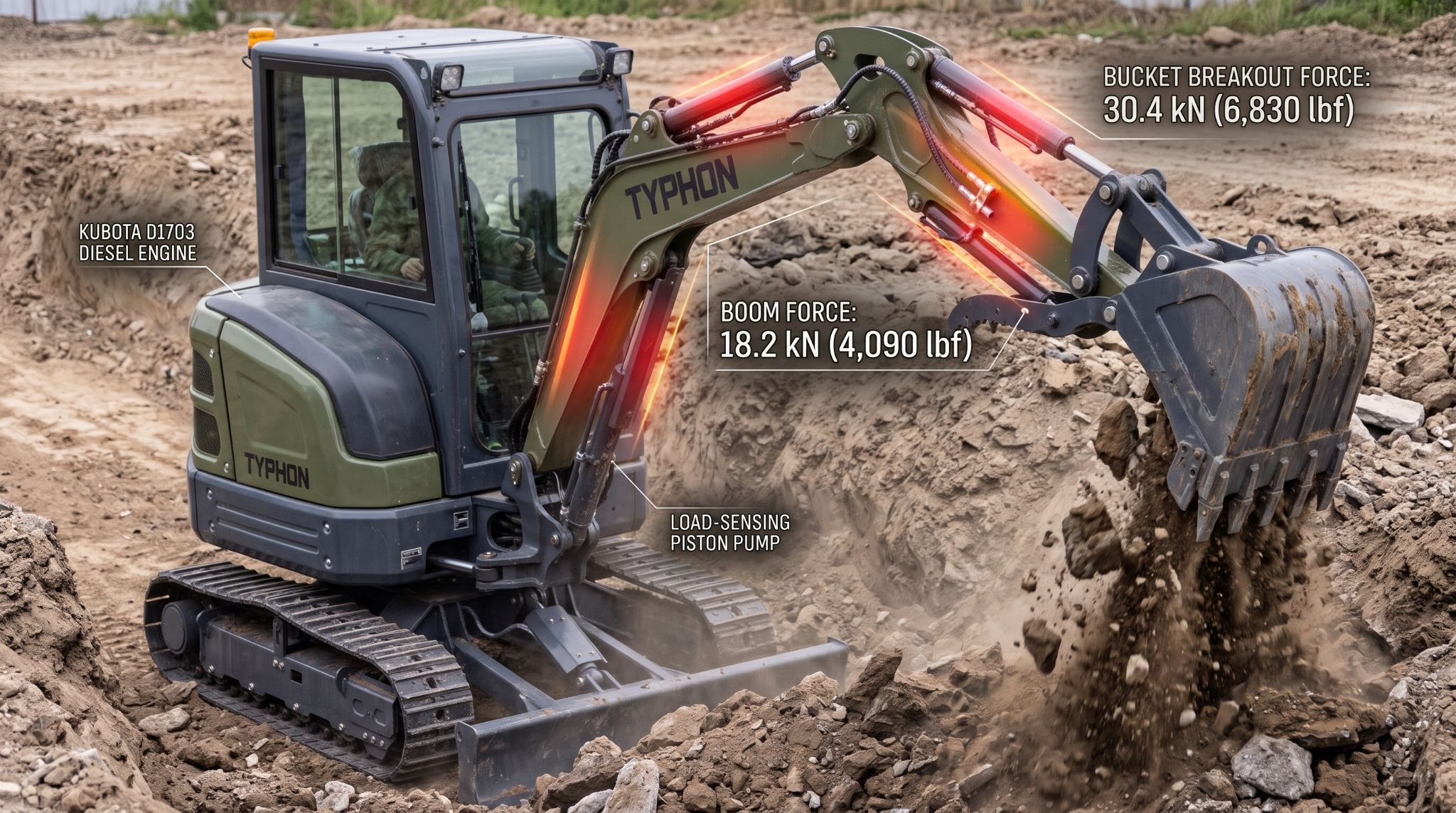
Breakout force is a product of hydraulic pressure acting on cylinder area. The KUVUO 4.0 delivers 30.4 kN (about 6,830 lbf) of bucket breakout force and 18.2 kN (about 4,090 lbf) of boom force. To produce those figures consistently, the pump has to reach full working pressure quickly when the bucket meets resistance, without drawing more power than the engine can supply.
The load-sensing pump does exactly that. Paired with the EPA-certified Kubota D1703 diesel producing 25 HP @ 2,200 RPM, the system converts the engine's low-end torque into pressure where it matters. The operator feels a machine that bites into hard ground and keeps pulling through the full 3,106 mm (just over 10 ft) digging depth instead of stalling at the bottom of the stroke.
Smooth Multi-Function Operation
The multi-way valve distributes flow among the boom, stick, bucket, swing, travel, and auxiliary circuits. Because the pump responds to the highest load signal, every active function receives the flow it needs. Combined with pilot controls, this gives operators proportional, predictable response. Feathering the boom down onto a pipe section feels as controlled as tearing out a stump, and that precision makes the KUVUO 4.0 equally capable in production digging and finish work around buried utilities.
Technical Spotlight: The 17.91 GPM Axial Piston Variable Pump in the TYPHON KUVUO 2.7
Demand-Matched Flow
The TYPHON KUVUO 2.7 KONSTRUCTZ Series uses an axial piston variable pump delivering 17.91 GPM (approximately 67.8 L/min) of hydraulic flow. In an axial piston variable pump excavator design, the pistons run parallel to the drive shaft, and displacement is controlled by the swashplate angle. As system pressure and demand change, the pump adjusts its stroke to match, so the machine avoids the constant full-flow output and wasted energy of a fixed gear pump.
This flow level is substantial for a 5,300 lbs machine. It feeds a 1.98 ft³ bucket through a 7.8 ft digging depth, 9.9 ft digging reach, and 11.5 ft digging height with responsive cycle times. Power comes from the Kubota D1105 three-cylinder direct-injection diesel, rated at 19 HP @ 2,200 RPM and up to 25 HP @ 3,000 RPM. Matching variable displacement to that engine keeps the D1105 working within its efficient range instead of lugging under unnecessary hydraulic load.
Smooth Pilot Control Response
The KUVUO 2.7 pairs its pump with full pilot joystick controls. Pilot controls send low-pressure signals to the main valve spools, giving the operator light, proportional input. When that input reaches a variable pump, the machine responds smoothly rather than jerking between full flow and none. Operators can grade, trench along a foundation, or set landscape stone with fine control, and the reduced joystick effort cuts fatigue over a long shift.
Attachment Support
Attachments need steady flow to perform at their rated output. An auger that loses flow stalls in dense soil. A thumb that responds unevenly makes material handling slow and imprecise. The KUVUO 2.7's 17.91 GPM output gives common attachments a consistent supply. Because the pump adjusts to demand, flow stays stable while the operator runs the attachment alongside boom and swing movements. That makes the KUVUO 2.7 a practical multi-tool carrier for landscaping, clearing, and utility work behind narrow gates.
Eliminating Hydraulic Drag: Simultaneous Tracking, Booming, and Curling
The Problem with Fixed-Flow Systems
Hydraulic drag occurs when a system wastes power pushing fluid that does no useful work. On a gear-pump machine, the pump delivers full flow at all times, so any excess passes through the valve or relief path and loads the engine without moving anything. When the operator combines functions, flow follows the path of least resistance. The lightly loaded circuit speeds up, the heavily loaded circuit slows down, and the engine drops RPM under the combined demand. Operators call this bogging down, and the only workaround is to sequence movements one at a time.
How Piston Pump Systems Solve It
Both TYPHON pump systems avoid that trap by adjusting displacement to demand. On the KUVUO 4.0, the load-sensing loop sets pump pressure from the highest active load. When the operator travels, lifts the boom, and curls the bucket at once, the pump raises output to meet the combined requirement while the multi-way valve distributes flow among the circuits. The machine keeps all three movements coordinated without starving the hardest-working function. The two-speed travel system (2.4 km/h low / 4.2 km/h high) adds pushing torque in low range during combined travel and digging.
On the KUVUO 2.7, the axial piston variable pump adjusts its stroke as demand changes, so it supplies more flow when the operator stacks functions and less when movements stop. With 2-speed travel (1.4 to 2.7 mph) and 58% gradeability, the machine can reposition on slopes while working the boom without the sudden engine sag typical of fixed-flow machines in its class.
What That Means for Productivity
Eliminating drag means faster cycles, steadier engine speed, and lower fuel consumption per cubic yard moved. It also means less heat. Every unit of energy that doesn't get bypassed is energy that doesn't end up in the hydraulic oil, which leads directly to the next performance factor.
Thermal Management: Maintaining Fluid Viscosity in Summer Operations
Why Heat Threatens Hydraulic Performance
Hydraulic oil does two jobs. It transmits power, and it lubricates and seals the pump's internal surfaces. Both depend on viscosity. As oil temperature climbs, viscosity drops. Thin oil leaks past piston and valve clearances, reducing volumetric efficiency and the force available at the cylinders. It also weakens the lubricating film between the pistons, cylinder block, and swashplate, which accelerates wear. Sustained heat hardens seals and breaks down the oil's additive package, shortening fluid life.
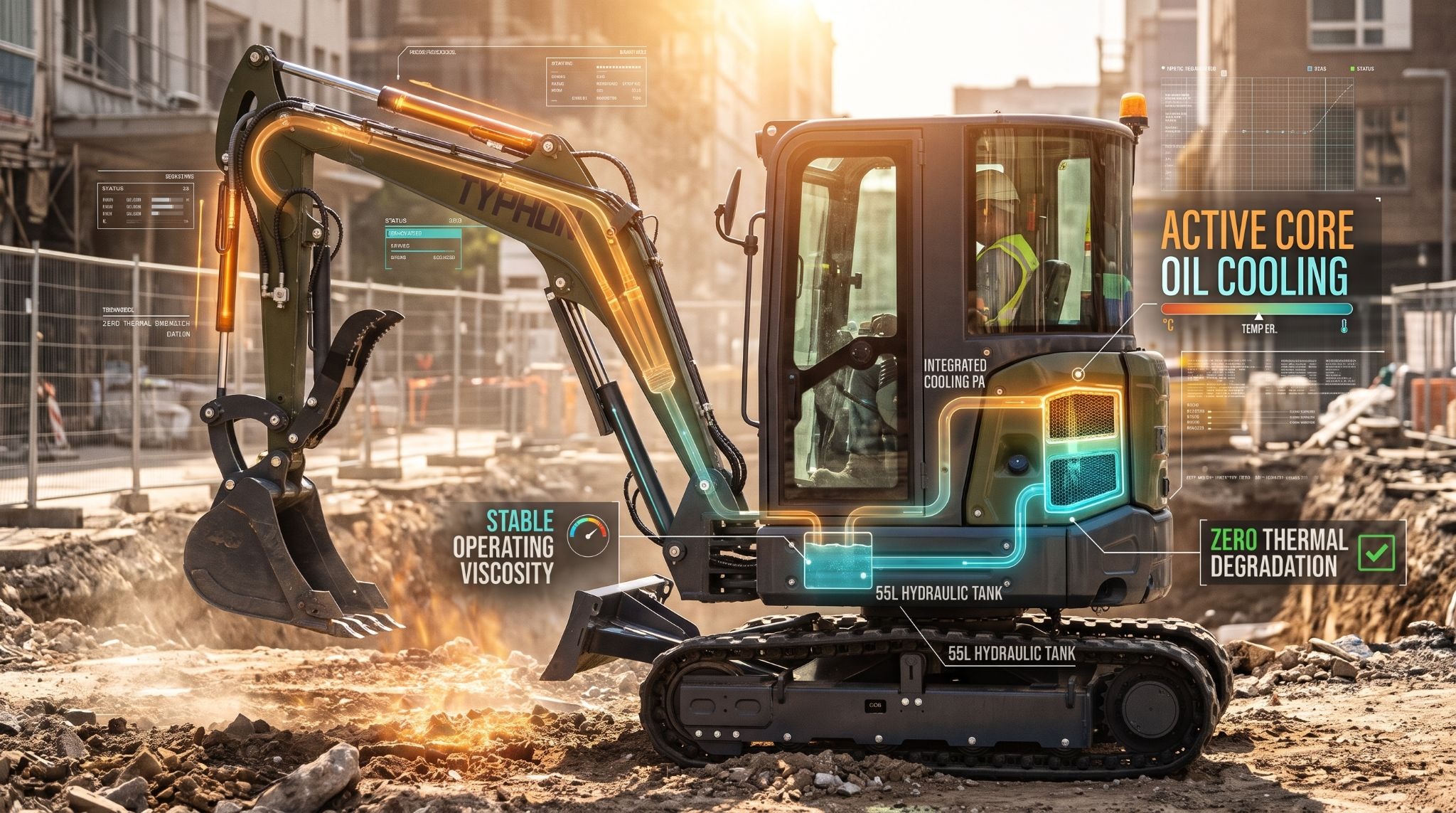
The TYPHON KUVUO 4.0 includes an integrated hydraulic oil cooler as standard equipment, supported by a 55 L hydraulic oil tank. The cooler removes heat from the returning oil, and the generous tank volume gives the fluid more time to shed heat before it cycles back to the pump. During long summer shifts running a breaker, auger, or continuous heavy digging, this combination holds oil within its working viscosity range. Pressure stays consistent, breakout force holds steady into the afternoon, and pump internals and seals operate under the conditions they were designed for.
Heat Control at the Source on the KUVUO 2.7
The most effective thermal strategy is generating less heat in the first place. The KUVUO 2.7's axial piston variable pump does this by matching output to demand rather than bypassing excess flow, which keeps the thermal load lower than that of a comparable gear-pump machine. Owners can protect that advantage by keeping the cooling package free of debris, holding oil at the correct level, and following the specified fluid grade and change intervals.
Protecting Your Investment
For both machines, thermal discipline is part of ownership. Keep cooler fins clean, especially after mulching, clearing, or dusty demolition work. Use the manufacturer's specified hydraulic fluid, and change filters on schedule. Clean, correctly rated oil at a stable temperature is what allows TYPHON hydraulics to deliver full performance across thousands of hours.
Conclusion: Hydraulic Architecture That Works as Hard as You Do
Pump design determines whether an excavator's horsepower turns into productive work or wasted heat. Gear pumps are simple, but fixed displacement leaves them prone to drag, bog-down, and thermal stress. Variable piston pumps adjust to the job, delivering smooth multi-function control, steadier engine speed, and longer component life.
The TYPHON KUVUO 4.0 pairs a 79.2 L/min load-sensing piston pump with an integrated oil cooler and a Kubota D1703 to deliver 30.4 kN of breakout force with precise control. The TYPHON KUVUO 2.7 pairs a 17.91 GPM axial piston variable pump with full pilot controls and a Kubota D1105 for responsive, efficient performance in a 5,300 lbs package. Both reflect the same engineering commitment: hydraulic systems built for real jobsite demands and long-term ownership confidence.
Explore the TYPHON KUVUO 4.0 Mini Excavator (SKU: TYPH-KUVUO) for load-sensing hydraulic performance and full 4-ton digging power.
Explore the TYPHON KUVUO 2.7 Mini Excavator, KONSTRUCTZ Series (SKU: TYPH-KUVUO27) for axial piston efficiency, smooth pilot response, and dependable attachment performance.