Scissor lift lifting stages: Mechanism, Safety & Control
By Machinery Team |
Published: August 21, 2026 |
Category: Jobsite Productivity
| 5 min read
What Are the Lifting Stages of a Scissor Lift?
A scissor lift raises workers and materials to height through a series of controlled stages, each one building on the last. Understanding these stages helps operators work more safely, position the machine correctly, and get the most out of every job. Whether you're handling maintenance, installation, or overhead repairs, knowing what happens at each point in the lift cycle gives you confidence and control.
A scissor lift is an aerial work platform that raises straight up using crossed, folding supports shaped like [scissors](https://www.scribd.com/document/260556659/MECH56). It doesn't reach outward the way a boom lift does; instead, it delivers stable vertical elevation directly above its base. That vertical motion moves through distinct stages, from a fully lowered platform on the ground all the way to maximum height and back down again.
In this post, we'll walk through the five key lifting stages of a scissor lift: ground level, initial lift, mid-level lift, maximum lift, and the lowering stage. For each one, you'll learn how the stage functions, what the operator does, and why it matters for safe, efficient operation.
Ground Level
Every lift cycle begins at ground level, with the platform fully lowered and resting at its lowest position. This is the starting point for all work, and it's where the machine is at its most stable and accessible. With the platform down, the scissor arms are fully folded and the center of gravity sits low, which makes the machine easy to move, load, and prepare. Ground level is where the groundwork for a safe lift is laid, both literally and figuratively.
At this stage, operators handle the essential setup tasks that make the rest of the cycle go smoothly. They step onto the platform, load tools and materials, and position the machine directly beneath or beside the work area. Because the platform is low, climbing aboard is simple and loading is straightforward, without the hazards that come with working at height. This is also the moment to confirm the machine sits on firm, level ground capable of supporting it safely.
Ground level matters more than it might appear, because decisions made here shape the safety of the entire lift.
Confirm stable footing, checking that the surface is firm, level, and free of hazards before raising the platform.
Load within capacity, distributing tools and materials evenly and staying within the machine's rated limits.
Position accurately, placing the machine so the platform will reach the work area without unsafe reaching or repositioning at height.
Taking the time to prepare properly at ground level pays off throughout the job. A machine that's correctly positioned, properly loaded, and set on stable ground rises safely and reaches the work exactly where it's needed. Rushing this stage, on the other hand, invites problems that only become more dangerous as the platform climbs. Ground level is the foundation of every safe, efficient lift.
Initial Lift
Cylinder thrust angle changes throughout lift elevation, demanding peak hydraulic pressure at ground level.
Once the machine is loaded and properly positioned, the initial lift begins. This is the moment the scissor mechanism starts extending, raising the platform steadily upward from the ground. The crossed scissor arms begin to open, and the platform rises smoothly and evenly as hydraulic power drives the movement. It's a controlled, gradual motion by design, giving the operator a clear sense of the lift beginning and time to confirm everything is behaving as it should.
During the initial lift, the operator's attention shifts to how the machine responds. This early stage is an ideal opportunity to notice whether the platform rises smoothly and evenly, without unusual noises, jerking, or hesitation. Because the platform is still low, any irregularity can be addressed safely before the machine climbs higher. A smooth, steady start signals that the hydraulic system and scissor mechanism are working as intended.
Several things are worth watching as the platform first leaves the ground:
Smooth, even motion, confirming the platform rises steadily without jerking or unusual sounds.
Stable balance, ensuring the load stays evenly distributed and the machine feels secure as it rises.
Clear surroundings, checking that no obstacles, people, or overhead hazards are in the platform's path.
The initial lift matters because it's the transition from the stability of ground level into elevated work, and it sets the tone for the rest of the cycle. Getting off to a smooth, controlled start reassures the operator that the machine is functioning properly and that it's safe to continue rising. This stage rewards patience and attention. By raising the platform steadily and confirming everything is in order early, operators carry that confidence upward into the higher stages of the lift, where a strong, stable start becomes even more valuable.
Mid-Level Lift
As the scissor arms continue to extend, the machine reaches the mid-level lift stage. Here the platform arrives at a practical working height that suits many common tasks. The scissor arms have opened further, raising the platform well above the ground while still keeping it comfortably below maximum extension. For a great deal of everyday work, this is the height where the job actually gets done, making the mid-level lift one of the most frequently used stages in the entire cycle.
This working height is ideal for a wide range of maintenance and installation activities. Tasks such as servicing equipment, installing fixtures, running conduit, or performing overhead repairs often fall right within this range. Operators position the platform at the height that puts the work comfortably within reach, then focus on the task at hand with a stable platform beneath them. Because the machine hasn't reached full extension, it retains a strong sense of stability while still providing meaningful elevation.
At the mid-level lift, the operator's focus turns fully to the work while maintaining safe practices on the elevated platform. Staying within the guardrails, keeping the load balanced, and remaining aware of surroundings all matter as much here as at any other height. The operator adjusts the platform's exact position to match the task, raising or lowering slightly as needed to work efficiently and comfortably.
The mid-level lift matters because it represents the productive heart of most scissor lift jobs. It delivers enough height to reach elevated work without pushing the machine to its limits, striking a practical balance between reach and stability. Understanding that many tasks can be accomplished at this comfortable working height helps operators work efficiently and safely, using only as much elevation as the job genuinely requires.
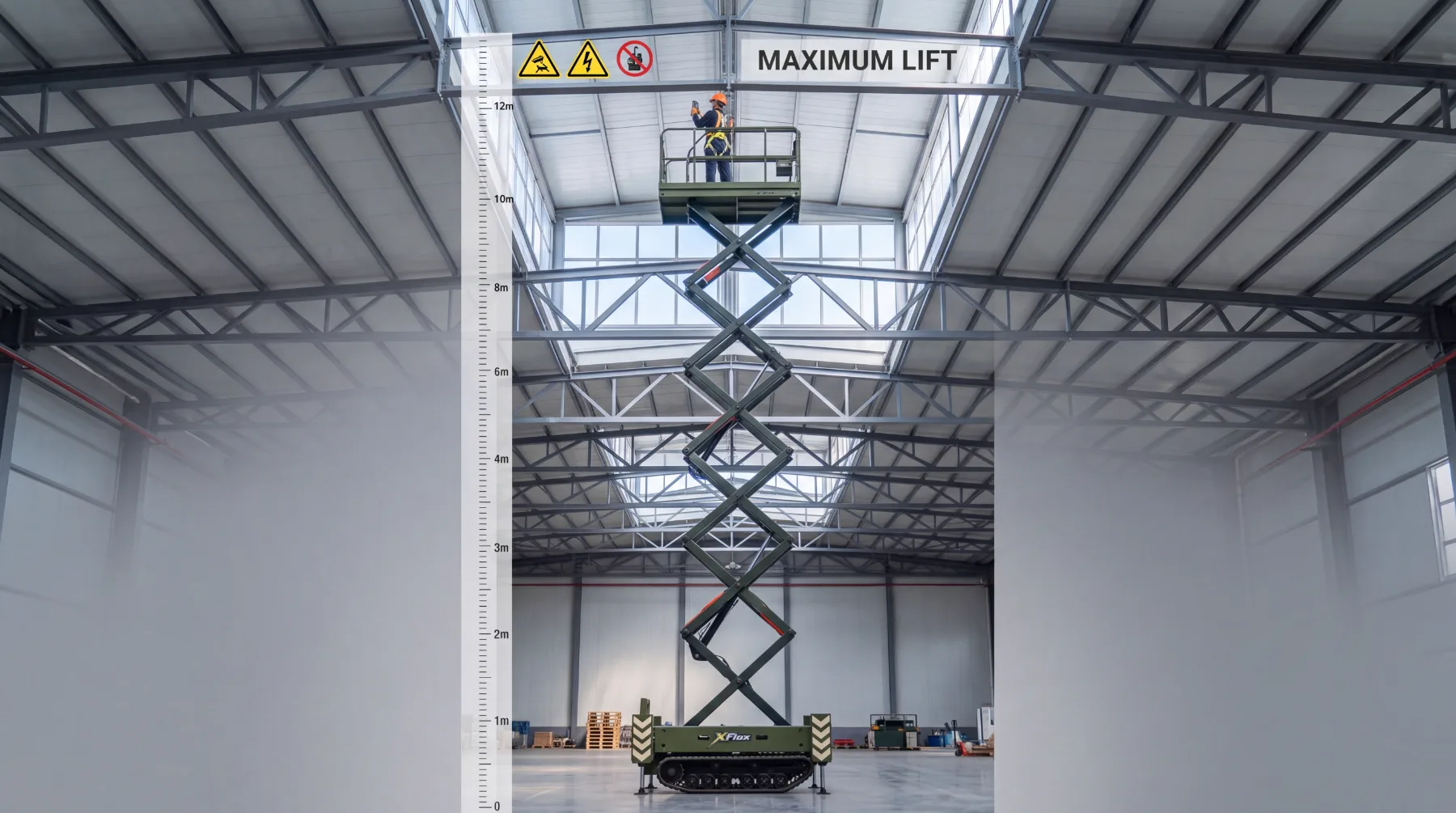
Maximum Lift
Mechanical maintenance props must be engaged before servicing scissor lift hydraulic cylinders.
The maximum lift stage is reached when the scissor arms extend close to their full height, raising the platform to its highest safe working position. At this point the crossed arms are nearly fully open, delivering the greatest reach the machine is designed to provide. This stage exists to handle work that simply can't be reached from lower heights, giving operators access to elevated areas that would otherwise be out of reach.
At maximum lift, operators tackle the highest work the machine can safely support, such as reaching ceilings, upper structures, tall equipment, or overhead installations. The key throughout this stage is working strictly within the machine's rated limits. Every scissor lift is engineered with a maximum height and a rated capacity, and staying within those specifications is what keeps operation safe at full extension. Reaching high is perfectly safe when it's done within the boundaries the manufacturer has established.
Because the platform sits at its highest point, extra care and awareness matter more here than at any other stage:
Respect rated limits, keeping both the height and the load within the machine's specified capacity.
Stay inside the guardrails, never leaning out or climbing to extend reach beyond the platform.
Watch for overhead hazards, including structures, fixtures, and power lines near the top of the lift.
Move deliberately, avoiding sudden shifts that could affect stability at full extension.
The maximum lift stage matters because it unlocks the full working range of the machine while demanding the greatest attention to safety. At full height, the platform is farther from its stable base, so disciplined operation within rated limits is essential. When operators respect those limits and stay alert to their surroundings, they can reach even the highest work areas safely, taking full advantage of what the scissor lift was built to do.
Lowering Stage
When the work is finished, the lift cycle enters its final stage: lowering. Here the scissor mechanism retracts, bringing the platform smoothly back toward the ground. The crossed arms fold together in a controlled motion as hydraulic pressure is released in a measured way, and the platform descends steadily until it returns to its lowest position. This stage completes the cycle, returning the machine to the stable, accessible state it started from.
The lowering stage deserves the same care and attention as raising the platform, even though the work is done. Operators guide the descent smoothly rather than dropping the platform quickly, keeping the motion controlled from top to bottom. Before and during lowering, it's important to confirm that the area below and around the machine is clear of people, tools, and obstacles. A descending platform can create pinch points and hazards for anyone nearby, so a clear space beneath the lift is essential for a safe return to the ground.
As the platform comes down, operators stay attentive to how the machine behaves, watching for smooth, even motion just as they did during the initial lift. Once the platform reaches ground level, they can safely step off, unload tools and materials, and either reposition the machine for the next task or shut it down. Returning to ground level also restores the machine to its most stable configuration for moving or storage.
The lowering stage matters because a safe job includes a safe finish. Bringing the platform down in a controlled way, with a clear area below, prevents accidents at the end of the cycle when it's tempting to relax attention. By treating the descent with the same discipline as the ascent, operators complete the lift safely and leave the machine ready for whatever comes next.
Conclusion
The lifting stages of a [scissor lift](https://typhonmachinery.com/product-category/scissor-lifts/) form a clear, logical cycle that moves from the ground up to full height and safely back down again. It begins at ground level, where the machine is loaded, positioned, and set on stable footing. The initial lift raises the platform smoothly off the ground, the mid-level lift delivers a practical working height for many maintenance and installation tasks, and the maximum lift extends the platform to its highest safe position for elevated work within the machine's rated limits. Finally, the lowering stage retracts the mechanism and returns the platform steadily to the ground. Understanding each of these stages, how it functions and what it demands of the operator, is the foundation of safe, efficient scissor lift operation from the first inch of travel to the last.