Scissor Lift vs. Forklift: Choosing the Right Equipment for Your Jobsite
By Machinery Team |
Published: September 17, 2026 |
Category: Equipment Comparison
| 5 min read
Scissor Lift vs. Forklift: Choosing the Right Equipment for Your Jobsite
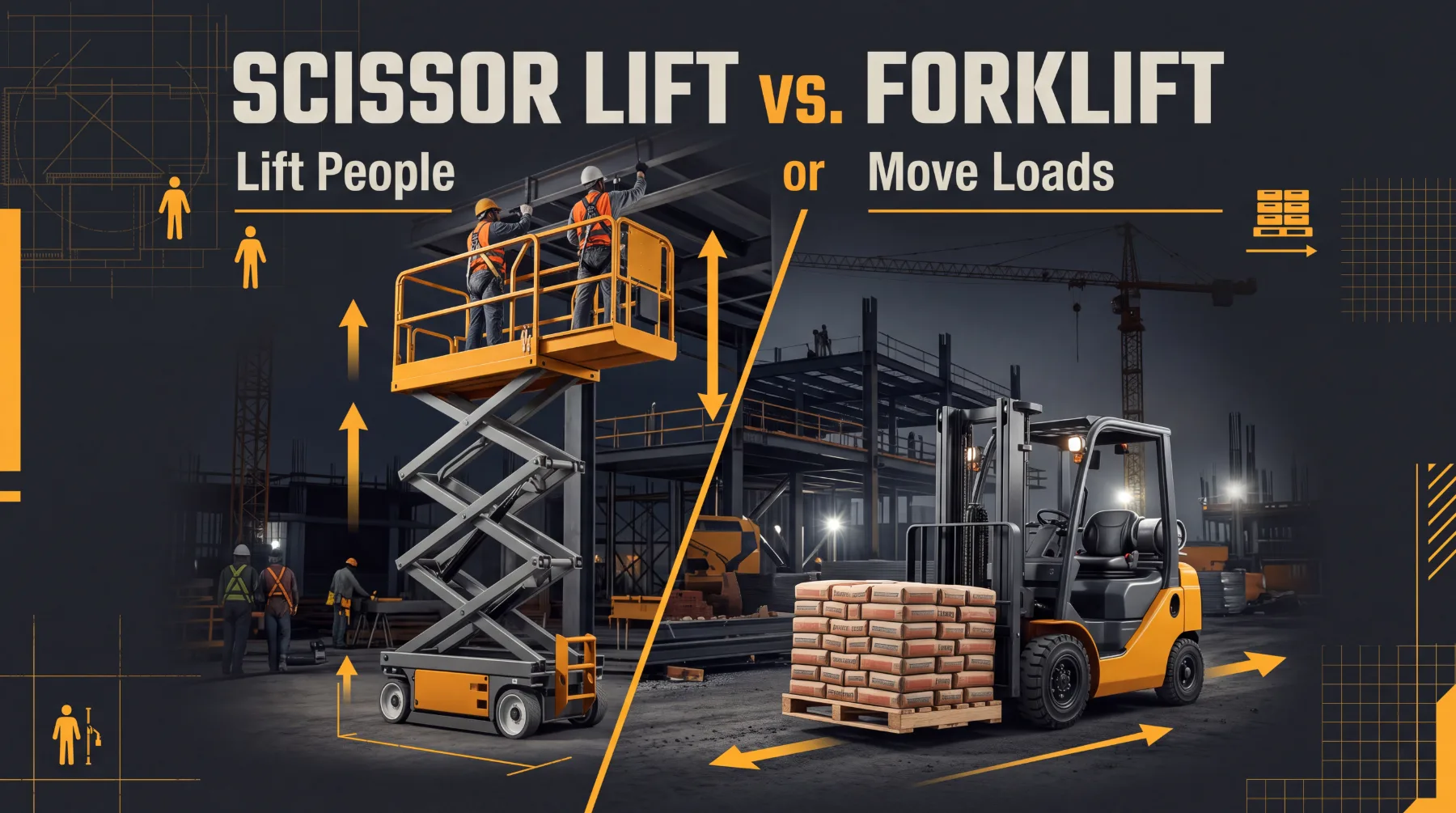
Two machines that lift, two entirely different jobs. Scissor lifts and forklifts both raise things off the ground, yet they solve very different problems on a jobsite. A [scissor lift](https://happymachinery.com/store/TYPHON-xFlex-4068ET-Electric-Rubber-Track-Scissor-Lift-3-2-Ton-with-5-4HP-Hydraulic-Pump-Motor-Drive-and-Hydraulic-Lifting-Cylinder-40-ft-Max-Lifting-Height-p837444761)raises people and their tools to work safely at height, while a forklift lifts and moves heavy loads from one place to another. Choosing the wrong one can leave you with equipment that slows your work or, worse, creates a safety risk. This guide breaks down what each machine is, how their lifting and working functions differ, how they handle jobsite conditions, and how to choose the one your project actually needs. By the end, you will know exactly which machine fits your task and be able to select with confidence.
What Is a Scissor Lift?
A scissor lift is an elevated work platform designed to raise workers and their tools straight up to a safe working height. Its name comes from the crisscrossing metal supports beneath the platform, which fold and unfold like the blades of a pair of scissors. As those linked supports extend, they push the platform upward in a controlled, vertical motion; as they contract, the platform lowers back down. This simple, dependable mechanism is what gives the scissor lift its steady, straight-up lifting action and its reputation as a reliable access solution.
The defining feature of a scissor lift is the stable elevated platform it provides. Unlike equipment that reaches out at an angle, a scissor lift raises a broad, level platform directly above its base, giving workers a secure, roomy surface to stand on and space to keep tools and materials within easy reach. Guardrails around the platform add an important layer of protection, making the machine a safe choice for tasks that keep workers elevated for extended periods.
Because of this design, scissor lifts are widely used wherever people need to work at height safely. Common applications include:
Installation work, such as fitting lighting, signage, ductwork, or ceiling fixtures.
Maintenance tasks, including repairs to walls, ceilings, and overhead systems.
Inspection jobs, where workers need a stable vantage point to examine structures or equipment.
Construction work, from finishing interior surfaces to accessing elevated sections of a build.
In each of these roles, the scissor lift earns its place by delivering safe, controlled vertical access. It lets a worker reach the job comfortably, stay steady while they work, and keep everything they need close at hand, which is precisely why it has become a trusted piece of equipment on so many jobsites.
What Is a Forklift?
A [forklift](https://happymachinery.com/store/New-2025-TYPHON-VIGOR-3-0-Blue-Electric-Forklift-3-Ton-Lifter-Lift-Truck-Jitney-Hi-Lo-p722911370) is a material-handling machine built to lift, transport, and position palletized or heavy loads. At the front of the machine sit two forks, the flat prongs that slide beneath a pallet or load to raise it, mounted on a vertical lifting mast. The mast raises and lowers the forks along its frame, allowing the operator to pick up material at ground level, lift it, and set it down precisely where it needs to go. This combination of forks and mast is the heart of the forklift, and it is what makes the machine so effective at moving weight that it would be impossible to shift by hand.
What sets a forklift apart from a scissor lift is its focus on the load rather than the operator. Where a scissor lift raises people to the work, a forklift brings material to where it belongs, carrying it across a site and lifting it to the required height. The operator drives the machine, maneuvering loads through aisles, around obstacles, and into position, whether that means loading a truck, stacking pallets on racking, or placing material at a work area.
This design makes the forklift a workhorse across many settings. It is a constant presence in warehouses, where it moves and stacks palletized goods efficiently, and it is equally at home on construction sites, handling heavy building materials and delivering them where crews need them. More broadly, the forklift suits nearly any material-handling application that involves moving substantial loads over distance and lifting them to varied heights. Its strength, reach, and mobility combine to make it an indispensable tool wherever heavy material must be transported and positioned quickly, safely, and reliably.
Comparing Lifting and Working Functions
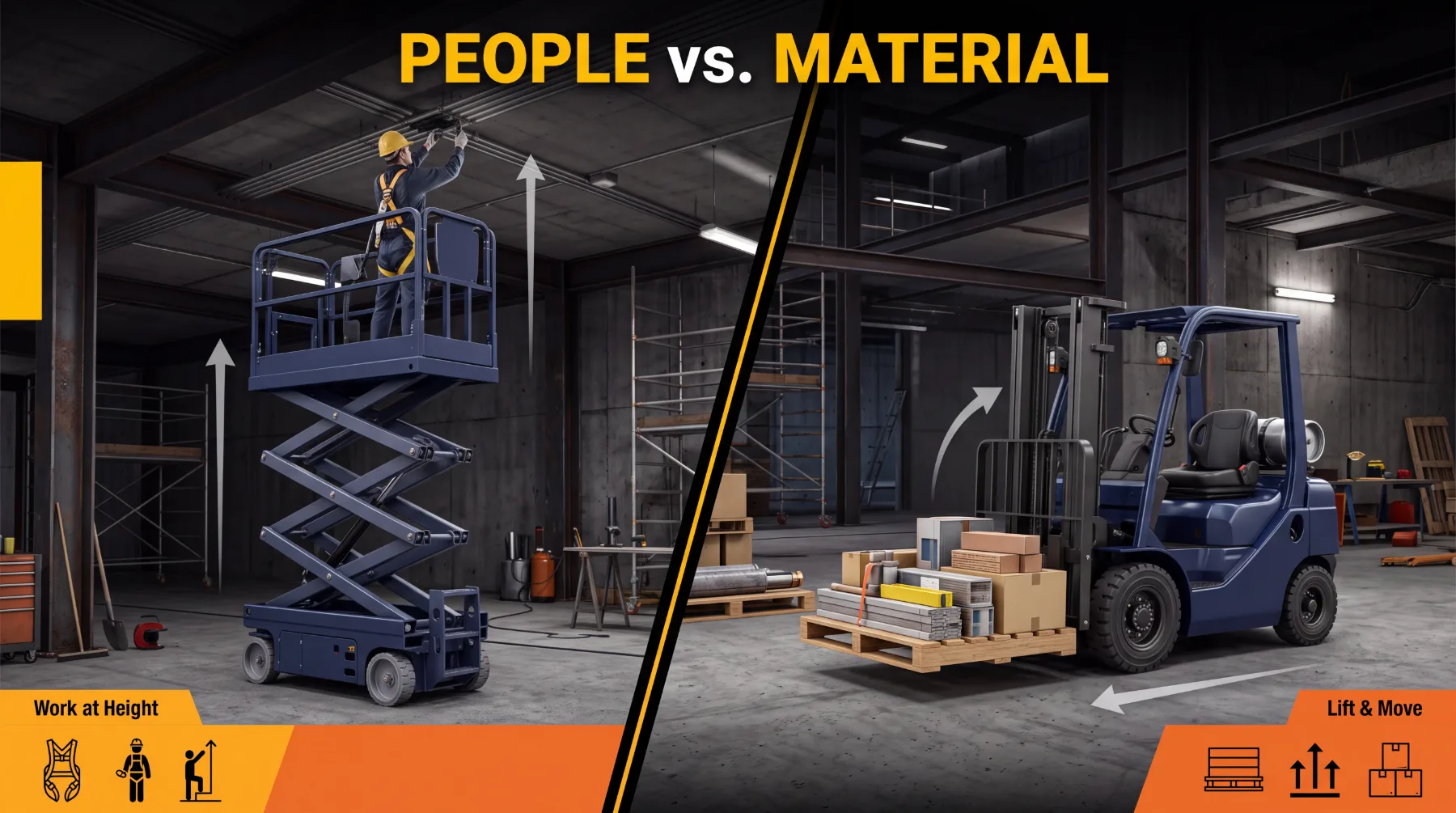
Scissor lifts provide broad, stable elevated work platforms for workers and their tools.
Although both machines lift, they are engineered for fundamentally different purposes, and understanding that contrast is the key to choosing correctly. A scissor lift is built to provide safe access to elevated work areas. Its entire design centers on raising workers and their tools to a height where they can perform a task, then keeping them stable and secure while they do it. The lifting function serves the worker, delivering a steady platform from which to install, repair, inspect, or build. The machine does not move material from place to place; it positions people so they can work productively above ground level.
A forklift, by contrast, is optimized for moving and stacking loads. Its lifting function serves the material, not the operator. The forks and mast are designed to raise heavy items, transport them across a site, and place them accurately, whether stacking pallets in a warehouse or setting building materials into position. The operator stays at the controls while the machine does the lifting and carrying, making the forklift a specialist in relocating and positioning weight rather than providing a workspace at height.
These different designs make each machine better suited to specific jobsite tasks. Consider how their strengths diverge:
Scissor lifts excel when the job requires a person to work at height for a sustained period, offering a broad, stable platform and room for tools.
Forklifts excel when the job requires moving heavy or palletized material, offering the strength and reach to lift and transport loads efficiently.
The distinction comes down to what needs to be elevated. If the answer is a worker who must perform a task at height, the scissor lift is the machine built for it. If the answer is material that must be lifted, carried, and stacked, the forklift is purpose-made for that work. Matching the machine's core function to the nature of your task ensures you get equipment that supports the job rather than working against it.
Maneuverability and Jobsite Conditions
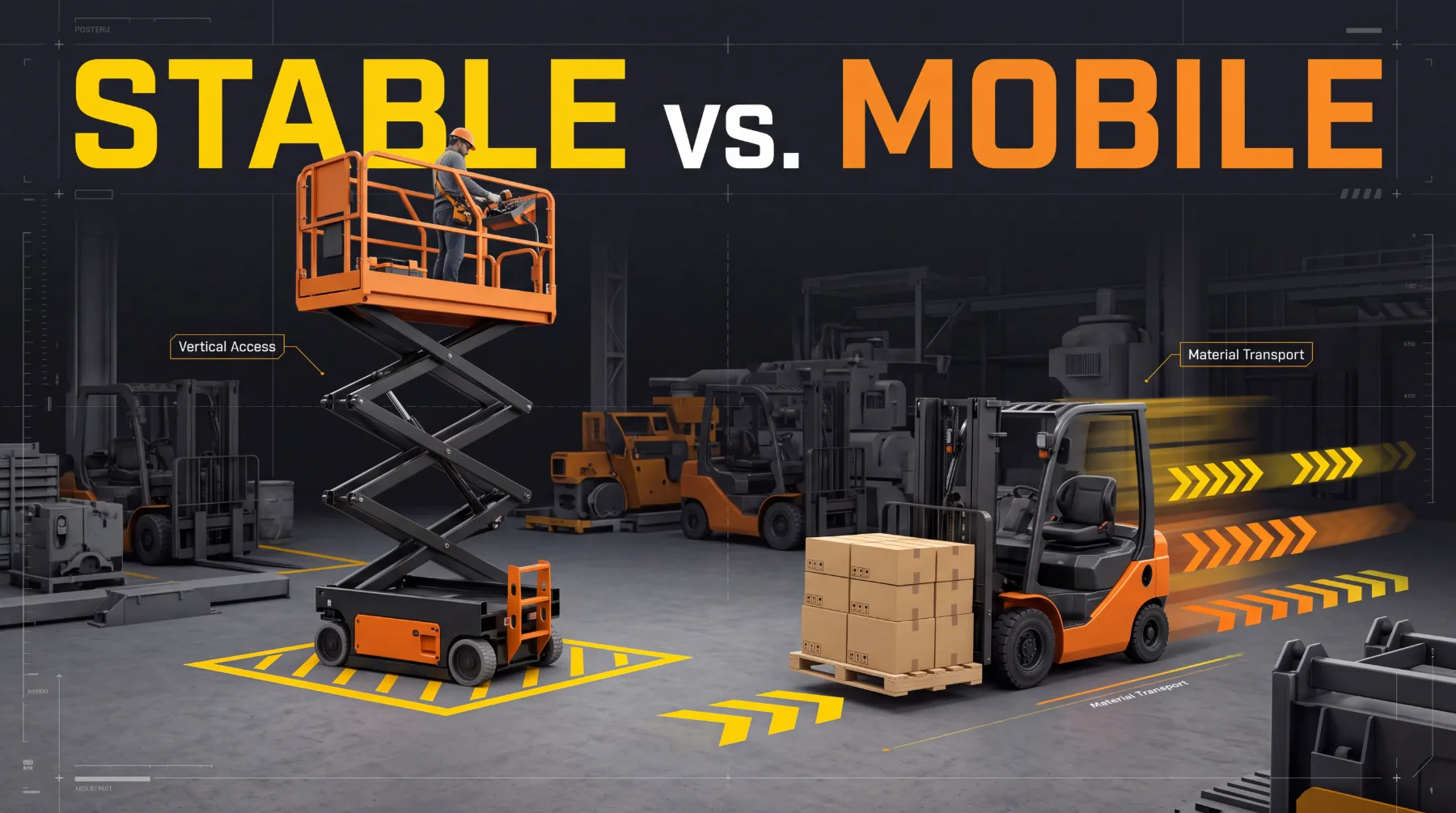
Forklifts are engineered specifically for rapid horizontal and vertical pallet transfer.
The conditions of your jobsite play a major role in which machine performs best, because each is designed to operate in a particular way. A scissor lift is most useful where workers need controlled vertical access across relatively level surfaces. The machine is built to raise a platform straight up from a stable base, and that stability depends on firm, even ground beneath it. On a level surface, a scissor lift can position workers safely at height, move steadily between work points, and provide the dependable access that overhead tasks require. It is well suited to indoor environments and prepared sites where the floor is solid and flat, giving the machine the secure footing its vertical lifting demands.
A forklift is designed for a different kind of mobility. Rather than holding a position and lifting straight up, it is built to transport materials and place them at different locations and heights across a site. The forklift travels with its load, carrying material through aisles, across yards, and around a construction site, then lifting it to whatever height the task calls for. This makes it the right choice whenever material must move from one point to another and be positioned in varied places, from ground level to high racking or elevated work areas.
The practical takeaway is that the two machines suit different working patterns. A scissor lift fits work that stays in place and reaches upward, ideally on level ground where its platform can stay stable. A forklift fits work that moves material around, transporting and placing loads wherever they are needed. Before choosing, assess your site honestly: consider whether the surface is level and firm enough for stable vertical access, how much your material needs to travel, and whether your task calls for keeping workers steady at height or delivering loads to changing locations. Matching the machine to these conditions ensures reliable, safe performance throughout the job.
Choosing the Right Equipment
Selecting between a [scissor lift and a forklift](https://asiamachinery.org/forklift-vs-scissor-lift-choosing-the-right-equipment-for-material-handling/) comes down to identifying what your job most needs the machine to lift: people or material. The guiding principle is straightforward. Choose a scissor lift when elevated personnel access is the priority, giving workers a stable platform to perform tasks at height. Choose a forklift when material lifting and transportation are the main requirements, moving and positioning heavy loads across your site. Getting this basic distinction right points you toward the correct machine before you weigh any other factor.
Once you have identified that core need, several practical considerations help you confirm the choice and select the right specifications. Weigh the following before deciding:
Lifting height, the height your workers or material must reach, ensuring the machine can achieve it safely.
Load capacity, the weight the machine must handle, whether that is workers and tools on a platform or heavy palletized material.
Surface conditions, since scissor lifts need level, firm ground for stable vertical access, while forklifts must travel across your terrain with a load.
Workspace, including the space available to operate and maneuver the machine in your environment.
The specific task, meaning whether the work involves staying in place to work at height or moving material from point to point.
These factors work together, so the best choice is the one where the machine's strengths align with your real conditions. A job that keeps workers overhead for installation or maintenance on a level floor points clearly to a scissor lift, while a job that demands moving building materials or stacking pallets points just as clearly to a forklift.
The dependable approach is to define your primary task first, then match the machine and its specifications to that task and your jobsite. Consider whether you are elevating people or material, how high and how heavy the load is, and what your surface and workspace allow. When you weigh these together honestly, the right equipment becomes clear, and you can invest with confidence in a machine that delivers safe, efficient performance for the work at hand.
Conclusion
Scissor lifts and forklifts both lift, but they serve entirely different purposes, and knowing that difference is what leads to the right choice. A scissor lift raises workers and their tools on a stable, elevated platform, making it ideal for installation, maintenance, inspection, and construction tasks that keep people working safely at height. A forklift lifts, transports, and positions heavy or palletized material using its forks and mast, making it indispensable in warehouses, on construction sites, and across material-handling work. Their designs suit different jobs: the scissor lift provides steady vertical access on level ground, while the forklift moves loads to varied locations and heights. To choose well, decide first whether your priority is elevating people or moving material, then weigh lifting height, load capacity, surface conditions, workspace, and the specific task. Match the machine to your real needs, and you will gain equipment that works with your operation, keeping your jobsite productive, efficient, and safe.
Frequently Asked Questions
1. What is the main difference between a scissor lift and a forklift?
The main difference lies in what each machine is built to lift. A scissor lift is designed to raise workers and their tools vertically, providing a stable elevated platform for tasks performed at height. Its crisscrossing supports extend to push a broad, level platform straight up, giving people a secure surface to work from. A forklift, by contrast, is built to lift, transport, and position palletized or heavy materials using its forks and lifting mast. Its purpose is to move loads rather than to elevate people. In short, a scissor lift serves the worker by providing safe access to elevated work areas, while a forklift serves the material by moving and stacking it across a site. When you frame the decision around whether you need to elevate a person or relocate a load, the right machine usually becomes clear, since each is purpose-built for its own kind of lifting.
2. What tasks is a scissor lift best suited for?
A scissor lift is best suited to work that requires a person to operate safely at height for a sustained period. Its stable, roomy platform and surrounding guardrails make it ideal for jobs where workers need both a secure footing and space to keep tools and materials within reach. Common applications include installation work such as fitting lighting, signage, ductwork, or ceiling fixtures, and maintenance tasks like repairing walls, ceilings, and overhead systems. It also suits inspection jobs, where a worker needs a steady vantage point to examine structures or equipment, and construction work, from finishing interior surfaces to accessing elevated sections of a build. In each case, the scissor lift delivers controlled vertical access on a broad platform, letting workers reach the job comfortably and stay steady while they complete it. It performs best on level, firm surfaces, which give its platform the stability that safe elevated work requires.
3. When should I choose a forklift instead of a scissor lift?
Choose a forklift when your primary need is moving and positioning heavy or palletized material rather than elevating people. A forklift's forks and lifting mast are designed to slide beneath a load, raise it, carry it across a site, and set it down precisely where needed. This makes it the right choice for work that involves transporting substantial weight over distance and placing it at varied heights. It excels in warehouses, where it moves and stacks palletized goods, and on construction sites, where it handles heavy building materials and delivers them to crews. More broadly, it suits nearly any material-handling application involving loads too heavy to move by hand. If your task centers on relocating material, loading trucks, stacking pallets, or positioning items at different locations and heights, a forklift is purpose-built for it. If instead your task requires a worker to perform a job at height, a scissor lift is the better fit.
4. Do scissor lifts and forklifts need different jobsite conditions?
Yes, the two machines are suited to different conditions. A scissor lift is most useful where workers need controlled vertical access across relatively level surfaces, because its platform rises straight up from a stable base and depends on firm, even ground for safe operation. This makes it well suited to indoor environments and prepared sites with solid, flat floors, where the machine can position workers securely at height. A forklift is designed for a different working pattern, built to transport materials and place them at different locations and heights across a site. It travels with its load through aisles, across yards, and around a construction site, then lifts material to the required height. Before choosing, assess your site honestly: consider whether the surface is level and firm enough for stable vertical access, how far your material must travel, and whether your task calls for keeping workers steady at height or delivering loads to changing locations.
5. What factors should I consider before selecting between the two?
Start by identifying your core need: elevated personnel access points to a scissor lift, while material lifting and transportation point to a forklift. Once you know that, weigh several practical factors to confirm the choice and select the right specifications. Consider the lifting height your workers or material must reach, ensuring the machine can achieve it safely. Look at load capacity, meaning the weight the machine must handle, whether that is workers and tools on a platform or heavy palletized material. Assess surface conditions, since scissor lifts need level, firm ground while forklifts must travel across your terrain with a load. Think about the workspace available to operate and maneuver the machine, and finally consider the specific task, meaning whether the work involves staying in place to work at height or moving material from point to point. Weighing these factors together against your real conditions leads you to the equipment that fits your job.