The Ultimate Guide to Heavy Compact Excavators: Sizing, Hydraulics, and Performance in the 2.7-Ton to 4-Ton Class

Key Takeaways
- Maintenance standards
- Safe operation
- Field inspection guidelines
The heavy compact excavator class sits in the most demanding zone of modern construction. These machines are expected to dig like mid-size equipment, travel on a standard trailer, work inches from finished structures, and stay productive through long seasons with minimal downtime. They carry most of the daily workload on residential builds, utility installations, commercial farms, and site development projects.
Choosing the right machine in this class is an engineering decision as much as a purchasing decision. Engine architecture, pump design, boom construction, cab environment, and undercarriage configuration all determine how a machine performs at hour 50 and at hour 5,000. Two excavators can share a similar weight class and still deliver very different results once they face hard clay, rocky fill, and back-to-back ten-hour shifts.
This guide breaks down the 2.7-ton to 4-ton class from an engineering perspective. You will learn when to step up from a 2-ton unit, which specifications predict real-world performance, and why protected boom design, load-sensing hydraulics, and climate-controlled cabs matter to your bottom line. Along the way, we detail the two TYPHON Machinery platforms built for this class: the TYPHON KUVUO 4.0 Mini Excavator (SKU: TYPH-KUVUO) and the TYPHON KUVUO 2.7 Mini Excavator, KONSTRUCTZ Series (SKU: TYPH-KUVUO27).
Executive Summary & Market Sizing: Stepping Up from 2.7-Ton to 4-Ton Units
The 2.7-Ton to 4-Ton excavator is often the first machine a contractor buys, and for good reason. Our machine handle irrigation trenching, light landscaping, and narrow-access work with excellent efficiency. As a business grows, though, the job mix changes. Deeper utility connections, larger foundation footprints, heavier pipe, and harder ground begin to push a 2-ton machine past its practical limits.
The Four Signals That It Is Time to Move Up
The first signal is digging depth. When crews regularly bench trenches or reposition to reach grade on sewer laterals, septic systems, or footing drains, the machine is too small for the work. Each workaround adds labor hours that never appear on the original bid.
The second signal is material resistance. Compacted clay, frost-hardened soil, and rock-laced fill expose the gap between a light machine and a properly weighted one. Breakout force depends on hydraulic pressure, but it also depends on the machine's mass to resist being pulled forward or lifted off the ground during a hard curl.
The third signal is attachment demand. Hydraulic breakers, augers, and thumbs need steady flow and a stable carrier. A 2-ton unit can run lighter tools, but heavier attachments strain its hydraulic capacity and reduce stability at reach.
The fourth signal is lifting and placement work. Setting catch basins, lowering pipe sections, and placing landscape stone call for a machine that stays planted at full extension. When operators feel the tracks getting light, the machine is working outside its comfort zone.
Why the 2.7-Ton and 4-Ton Tiers Both Matter
The heavy compact class is not a single step. It is two distinct tiers that solve different problems. The 2.7-ton tier delivers a major jump in digging capability while keeping the footprint narrow enough for gate access and tight residential lots. The 4-ton tier adds serious mass, deeper reach, and higher hydraulic output for contractors who run sustained heavy excavation and want a machine that behaves like a larger excavator in a compact envelope.
TYPHON Machinery engineered one platform for each tier. The KUVUO 2.7 is built for contractors who need access agility and protected durability. The KUVUO 4.0 is built for contractors who need maximum digging force and reach without stepping into full-size transport and site-disruption costs. Both are powered by Japanese Kubota diesel engines, both use piston-pump hydraulics, and both come with an enclosed AC/heater cab as standard equipment.
Technical Spotlight: TYPHON KUVUO 4.0 (SKU: TYPH-KUVUO)
The TYPHON KUVUO 4.0 Mini Excavator operates in the 4-ton class at approximately 8,800 lbs. It is engineered as a complete, premium production machine rather than an entry-level platform with performance and comfort features held back as upgrades.
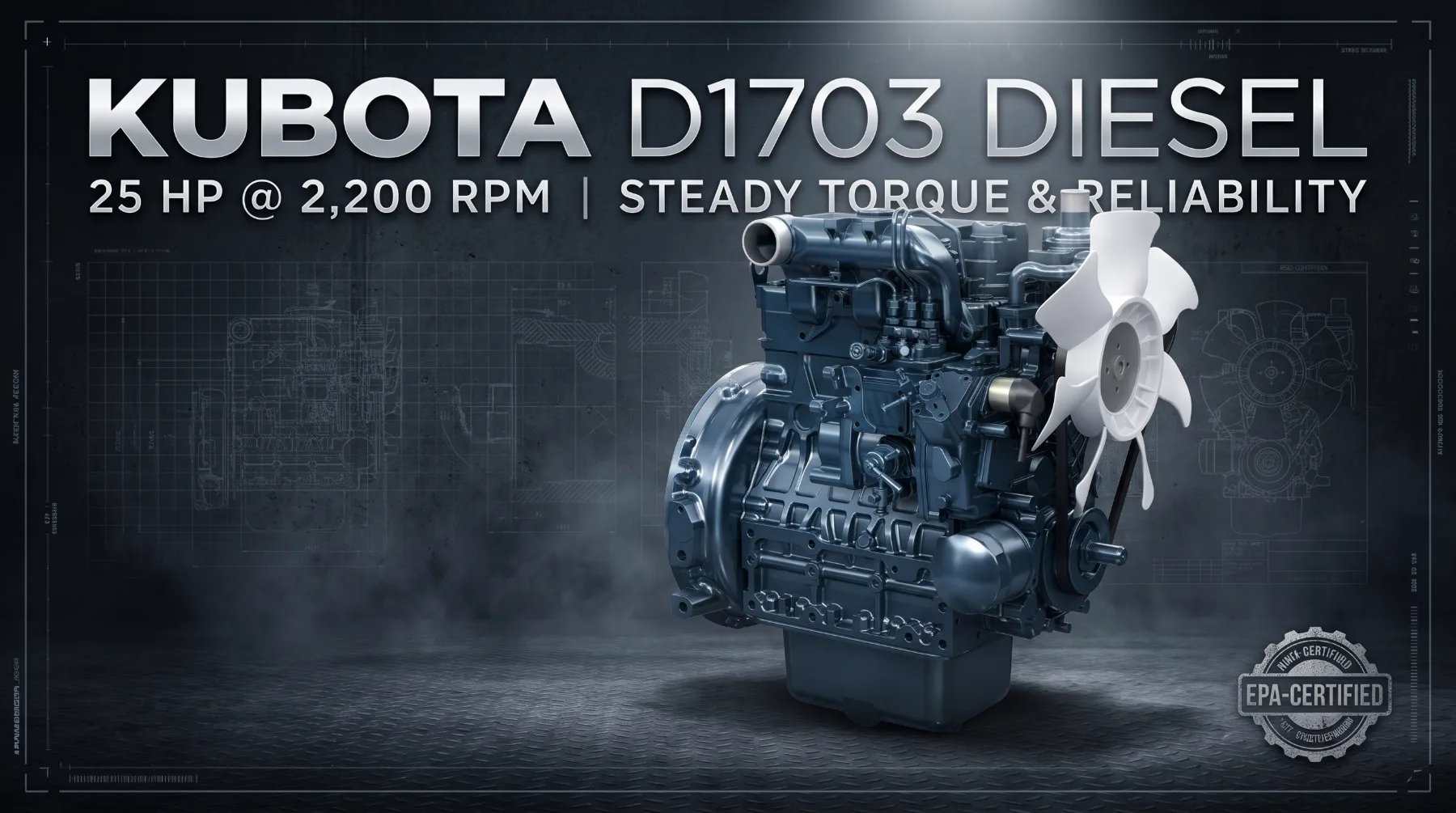
At the core of the KUVUO 4.0 is an EPA-certified Japanese Kubota D1703 diesel engine producing 25 HP @ 2,200 RPM. The D1703 is a three-cylinder industrial engine with a long service record in compact equipment worldwide. Its value in an excavator comes from its torque behavior. Digging does not reward high engine speed. It rewards steady torque that keeps the hydraulic pump fully supplied when the bucket meets resistance. The D1703 holds its pace under load rather than lugging down, which keeps cycle times consistent through the entire shift.
The ownership advantage is just as significant. Kubota engines are supported by a global parts and service network. Filters, gaskets, injectors, and wear components are widely available, and most diesel technicians already know the platform. Gray-market machines built around unverified or rebadged engines rarely offer that assurance. When a component fails on one of those machines, the downtime clock starts and may not stop for weeks.
Digging Performance
The KUVUO 4.0 delivers 30.4 kN (about 6,830 lbf) of bucket breakout force and 18.2 kN (about 4,090 lbf) of boom force, with a maximum digging depth of 3,106 mm (just over 10 ft). Those figures define the machine's working envelope. A 10-foot depth covers most residential utility connections, foundation excavations, drainage systems, and agricultural trenching in a single setup. Strong bucket force produces fuller buckets in compacted material, and strong boom force maintains pull through the complete digging stroke.
Hydraulics: Load-Sensing Variable-Displacement Piston Pump
The KUVUO 4.0 uses a variable-displacement piston pump with a load-sensing system rated at 79.2 L/min (about 20.9 GPM), paired with a multi-way valve and a hydraulic oil cooler. This is the feature that most clearly separates it from lower-cost competitors.
Many budget excavators rely on fixed-displacement gear pumps. A gear pump delivers constant flow regardless of demand, so unused flow is pushed across relief valves and turned into heat. Under combined functions, such as curling, lifting, and swinging at once, gear-pump machines often bog down or force the operator to sequence movements one at a time.
A load-sensing piston pump reads actual circuit demand and adjusts displacement to match. When the operator calls for multiple functions, flow is distributed where it is needed, and movement stays smooth and simultaneous. Because the pump only produces the flow the job requires, the system runs cooler and wastes less fuel. The integrated oil cooler protects fluid viscosity during sustained heavy work, preserving seals, valves, and pump internals over thousands of hours.
Footprint, Swing, and Undercarriage
The KUVUO 4.0 features True Zero Tail Swing with a 1,554 mm upper structure width that stays within the 1,720 mm overall machine width through full rotation. Operators can work tight against a foundation, fence line, or traffic lane and swing without rear impact risk. An independent Boom Swing function lets the boom offset from the house, so crews can dig straight trenches alongside walls without repositioning the entire machine.
The undercarriage uses metal tracks with a 2,150 mm track length and 300 mm track shoes, providing stable footing for lifting and breakout work. Two-speed travel (2.4 km/h low / 4.2 km/h high) gives operators pushing torque when needed and faster relocation across the site. Capacities include a 50 L fuel tank and a 55 L hydraulic oil tank, supporting full shifts without mid-day refueling.

Every KUVUO 4.0 ships with an enclosed AC/heater cabin, pilot controls, LED work lights, a regular digging bucket, a hydraulic thumb clip, a toolbox, and a digital manual. The thumb clip turns the machine into a material handler from day one, ready for logs, rock, brush, and demolition debris.

The TYPHON KUVUO 2.7 Mini Excavator (KONSTRUCTZ Series) is engineered for contractors who need a significant step up from 2-ton capability while keeping the access flexibility that tight residential and landscaping sites demand.
Powertrain: Kubota D1105 Diesel
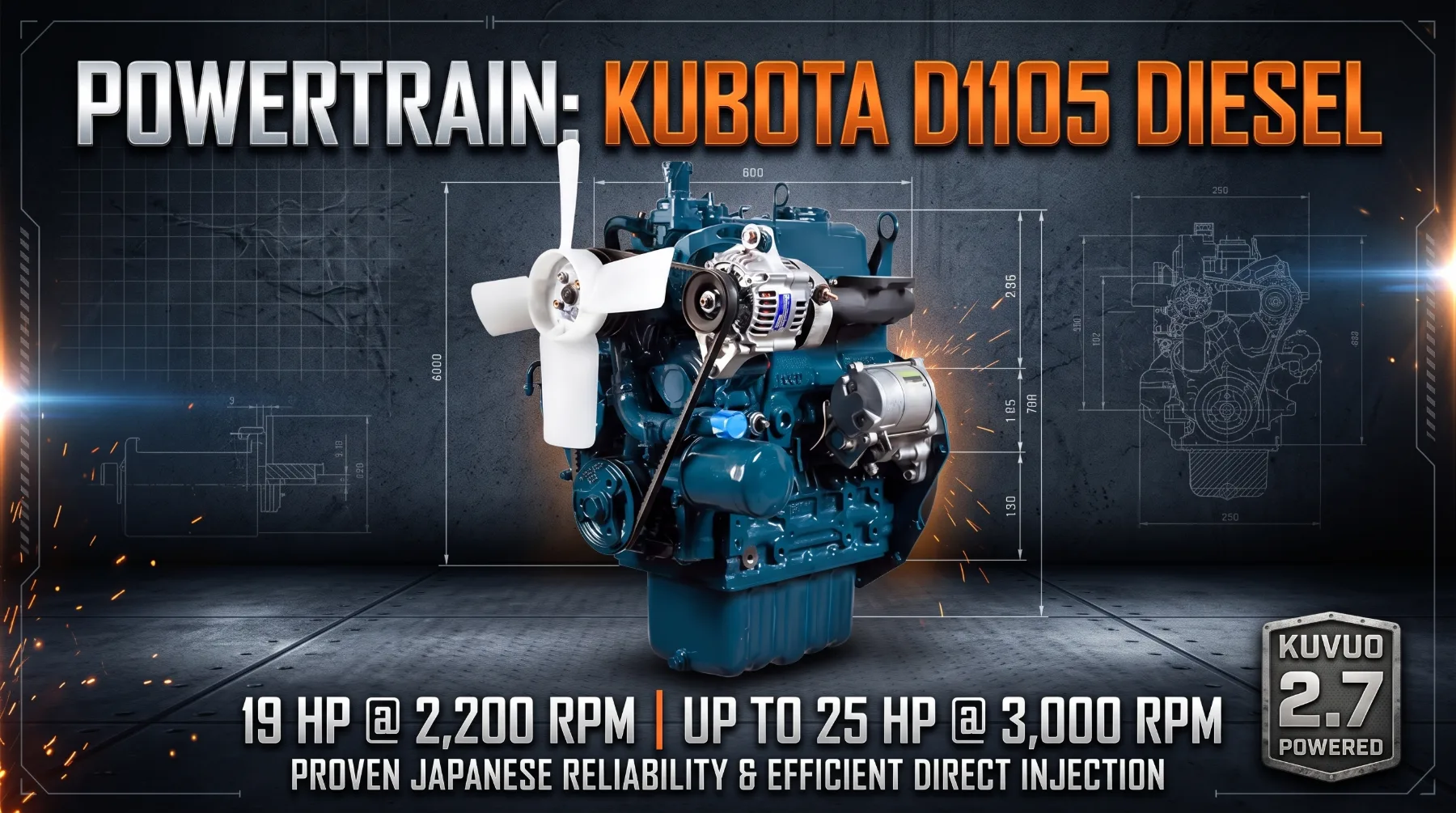
The KUVUO 2.7 is powered by a proven Japanese Kubota D1105 three-cylinder direct-injection diesel, rated at 19 HP @ 2,200 RPM and up to 25 HP @ 3,000 RPM. Direct injection delivers efficient combustion and responsive torque, and the D1105 shares the same global support advantage as every Kubota platform. For fleet managers running mixed equipment, standardizing on Kubota engines simplifies parts stocking and technician training across the entire lineup.
Weight, Digging Envelope, and Capacity
At 5,300 lbs operating weight, the KUVUO 2.7 carries meaningfully more mass than a 2-ton unit, which translates into better stability during breakout and lifting. It delivers a 7.8 ft digging depth, 11.5 ft digging height, and 9.9 ft digging reach, with a 1.98 ft³ bucket capacity that moves more material per cycle. The 5.30 gal fuel tank pairs with the efficient D1105 for productive working days.
Hydraulics: Axial Piston Variable Pump
The KUVUO 2.7 uses an axial piston variable pump delivering 17.91 GPM of hydraulic flow. Like the KUVUO 4.0, it adjusts output to demand rather than running constant flow, which produces smoother multi-function control, lower heat generation, and better fuel economy than gear-pump machines in its weight range. That flow supports thumbs, augers, and other common attachments with steady, predictable performance.
Undercarriage and Travel
One of the KUVUO 2.7's defining features is its retractable metal track system, adjustable from 39.0 in to 51.2 in. Retracted, the machine fits through narrow gates and between structures. Extended, it gains a wider stance for stability during digging and lifting. The replaceable metal tracks handle rocky and abrasive ground, and the hidden travel drive motor keeps a critical drivetrain component shielded from impact and debris. Two-speed travel (1.4–2.7 mph) and 58% gradeability give the machine confident mobility on slopes and uneven terrain.
Boom Structure and Swing
The KUVUO 2.7 uses an inverted boom design that positions the boom cylinder inside the boom for debris and rock protection, along with a one-piece cast boom connection for structural integrity at the highest-stress joint. Boom swing of 45° left / 55° right allows offset digging along foundations and fence lines.
Cab and Controls
The enclosed cab with factory A/C and heater includes a high-back adjustable seat with armrests and full pilot joystick controls. This level of operator environment is rare in this weight class, where many competing machines ship with open canopies and mechanical linkages.

Protected Engineering: Inverted Boom Cylinders vs. Exposed Top-Mounted Designs
Most compact excavators mount the boom cylinder on top of the boom, fully exposed. On a clean grading job, that layout works acceptably. On demolition sites, rocky excavations, land-clearing projects, and brush work, it becomes a liability.
The Real-World Damage Risk
An exposed top-mounted cylinder faces constant contact risk. Falling rock from a trench wall, swinging logs during clearing, rebar and concrete fragments during demolition, and low branches during brush work can all strike the cylinder rod or barrel. A single impact can score the chrome rod surface. Once that surface is damaged, every extension and retraction drags the scored section through the rod seal. The seal begins to leak, contaminants enter the cylinder, and wear accelerates through the hydraulic circuit.
A more severe strike can bend the rod outright. A bent boom cylinder rod typically takes the machine out of service until the cylinder is rebuilt or replaced. For a contractor mid-project, that means a stalled crew, possible rental costs for a replacement machine, and schedule penalties that can far exceed the repair bill.
How the KUVUO 2.7 Inverted Boom Solves the Problem
The TYPHON KUVUO 2.7 positions the boom cylinder inside the boom structure. The steel boom itself becomes a shield, absorbing impacts that would otherwise land on the rod and barrel. Rock spill, debris, and branches strike structural steel designed to take that abuse instead of a precision-machined hydraulic component.
This design is reinforced by the one-piece cast boom connection, which eliminates the welded joints that can fatigue and crack under repeated shock loading. Together with the hidden travel drive motor, the inverted boom reflects a consistent engineering philosophy: protect the components that are expensive to repair and critical to uptime.
The Downtime Cost Equation
From a fleet management perspective, protected engineering is a total-cost-of-ownership decision. A cylinder rebuild involves parts, labor, fluid replacement, and lost production days. Multiply that exposure across a season of demolition, clearing, and rock work, and the value of a protected boom becomes clear. Contractors working in harsh conditions gain more than a stronger machine. They gain a more predictable maintenance budget and a more reliable schedule.
All-Weather Climate Control Cabins & Full Pilot Controls: The ROI Behind Operator Comfort
Operator comfort is often treated as a luxury. From an engineering and fleet management standpoint, it is a productivity system. Both the KUVUO 4.0 and the KUVUO 2.7 include enclosed AC/heater cabs and pilot controls as standard, because the operator environment directly affects output, accuracy, and retention.
Climate Control as a Production Tool
Heat and cold degrade human performance. In summer, an operator in an open canopy loses focus as the day wears on, and precision suffers during the afternoon hours when fatigue peaks. In winter, cold hands lose fine motor control, making careful work around buried utilities slower and riskier. An enclosed, climate-controlled cab holds conditions steady, so the operator delivers the same quality of work in the tenth hour as in the first.
Enclosed cabs also protect operators from dust, noise, rain, and wind. Less environmental stress means fewer breaks, more consistent cycle times, and fewer weather-related schedule losses. Across a full season, those recovered hours add up to measurable revenue.
Pilot Controls and Precision Work
Pilot controls use low-pressure hydraulic signals to actuate the main control valves, rather than direct mechanical linkages. The result is lighter joystick effort and smooth, proportional response. Operators can feather movements with fine precision, which matters when grading to tolerance, exposing gas lines, or setting pipe on grade. Reduced hand and forearm strain also lowers fatigue over long shifts.
When pilot controls are paired with a load-sensing or variable piston pump, the machine responds exactly as the operator intends. Multi-function movements stay coordinated, and the operator spends less mental energy compensating for jerky or uneven response.
Operator Retention and Recruiting
Skilled operators are one of the most valuable assets a contractor has, and they know the difference between a well-equipped machine and a bare-bones one. Providing a climate-controlled cab, an adjustable high-back seat, and pilot controls signals that the business invests in its people. That investment supports retention, reduces the cost of recruiting and training replacements, and helps attract experienced talent in a competitive labor market.
Summary Comparison Table
The table below summarizes the key specifications for both TYPHON heavy compact excavators.
Specification | TYPHON KUVUO 4.0 (TYPH-KUVUO) | TYPHON KUVUO 2.7 KONSTRUCTZ (TYPH-KUVUO27) |
|---|---|---|
Operating Class | 4-Ton (~8,800 lbs) | 2.7-Ton (5,300 lbs) |
Engine | EPA-certified Kubota D1703 Diesel | Kubota D1105 3-Cylinder Direct-Injection Diesel |
Horsepower | 25 HP @ 2,200 RPM | 19 HP @ 2,200 RPM / up to 25 HP @ 3,000 RPM |
Max Digging Depth | 3,106 mm (approx. 10.2 ft) | 7.8 ft |
Hydraulic System | Load-sensing variable-displacement piston pump, multi-way valve, oil cooler | Axial piston variable pump |
Hydraulic Flow | 79.2 L/min (approx. 20.9 GPM) | 17.91 GPM |
Track Configuration | Metal tracks, 300 mm shoe, 1,720 mm overall width | Retractable metal tracks, 39.0 in to 51.2 in |
Travel Speed | 2-speed: 2.4 km/h low / 4.2 km/h high | 2-speed: 1.4–2.7 mph, 58% gradeability |
Cab Type | Enclosed AC/Heater cabin, pilot controls | Enclosed AC/Heater cab, full pilot joystick controls |
Boom Swing | Independent boom swing with True Zero Tail Swing | 45° left / 55° right, inverted protected boom |
Which Machine Fits Your Operation
Choose the TYPHON KUVUO 4.0 when your work centers on deep utility trenching, foundation excavation, heavy lifting, and sustained production digging. Its 30.4 kN breakout force, 10-foot reach, high-output load-sensing hydraulics, and True Zero Tail Swing make it the strongest choice for contractors who want near mid-size performance in a compact, site-friendly envelope.
Choose the TYPHON KUVUO 2.7 KONSTRUCTZ Series when access, terrain, and harsh-site durability drive your decision. Its retractable tracks, inverted protected boom, hidden travel motor, and 58% gradeability make it ideal for landscapers, demolition crews, land clearers, and residential contractors working behind gates and on slopes.
Conclusion
The 2.7-ton to 4-ton class is where compact excavators earn their place as primary production machines. Success in this class depends on more than horsepower or weight. It depends on a proven engine with global parts support, a hydraulic system that delivers power efficiently under combined loads, structural protection for critical components, and an operator environment that sustains precision through every shift and every season.
TYPHON Machinery built the KUVUO 4.0 and KUVUO 2.7 around exactly those principles. Kubota power, piston-pump hydraulics, protected engineering, and climate-controlled pilot-control cabs come standard, giving you a lower total cost of ownership and a clear advantage over gear-pump competitors and gray-market imports.
Explore the TYPHON KUVUO 4.0 Mini Excavator (SKU: TYPH-KUVUO) for maximum digging force, reach, and zero tail swing performance.
Explore the TYPHON KUVUO 2.7 Mini Excavator, KONSTRUCTZ Series (SKU: TYPH-KUVUO27) for access agility, protected boom durability, and all-terrain confidence.
Match the machine to your workload, and give your crew equipment engineered to perform from the first bucket of the season to the last.