Stone Crusher Conveyor Systems for Material Handling
Key Takeaways
- Maintenance standards
- Safe operation
- Field inspection guidelines
Stone Crusher Conveyor Systems for Material Handling
A stone crusher can only produce as fast as its conveyors carry material away. When the discharge belt slips, spills, or backs up, crushed rock builds beneath the machine. Then it packs the chamber and stops the whole plant. Loaders wait, trucks queue, and a productive shift turns into a cleanup job. On many crushing sites, the conveyor decides daily tonnage as much as the crusher does.
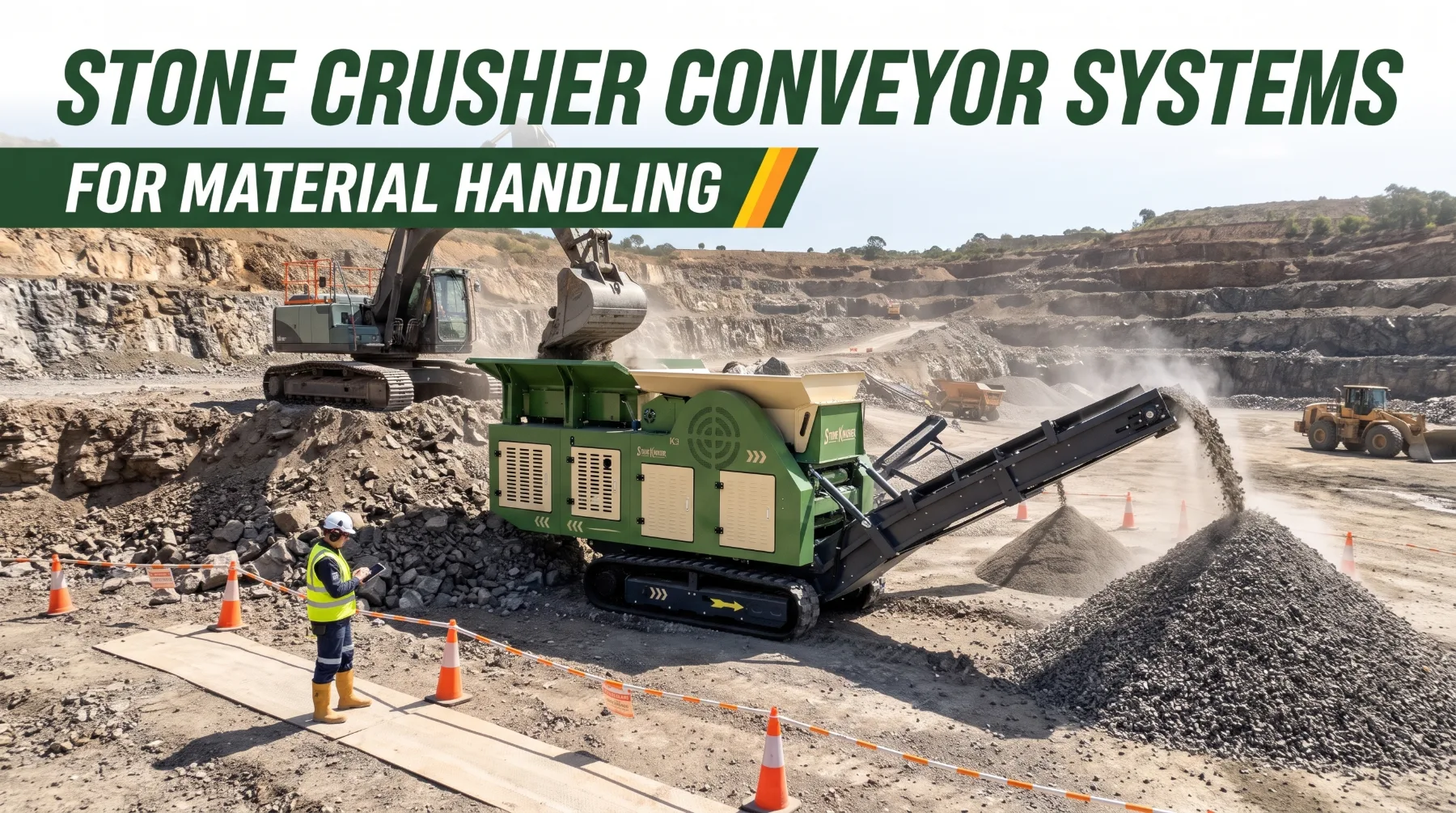
Stone crusher conveyor systems move crushed material from the crushing chamber to stockpiles, screens, secondary crushers, or trucks. A well-matched conveyor keeps that flow steady, reduces repeated loader handling, and builds clean, well-shaped stockpiles. A poorly matched or neglected conveyor creates spillage, segregation, and premature wear. It also creates some of the most serious entanglement hazards on any aggregate site.
The discharge conveyor carries crushed material away from the crushing chamber as fast as the crusher produces it. On a mobile jaw, cone, or impact crusher, material drops from the chamber onto the main conveyor beneath it. The belt then lifts it out to a stockpile or the next processing stage. Without that steady removal, the product builds under the crusher until it rises into the discharge opening and chokes the machine from below.
Most mobile crushing plants use more than one conveyor. The main discharge conveyor carries the crushed product. Many machines also have a side conveyor that takes fines scalped by the pre-screen or grizzly, so that material bypasses the chamber and forms a separate stockpile. An overband magnet often sits above the main conveyor to lift tramp steel out of recycled concrete and demolition material. On larger plants, stacking conveyors, screen conveyors, and transfer belts connect several machines into one circuit.
Conveyor configuration and capacity should match both the crusher's expected output and the needs of downstream equipment. A discharge belt that runs at the crusher's full rated output can still back up if the screen it feeds is overloaded. The same happens if a secondary crusher runs behind or the stockpile has nowhere to grow. Think of the conveyor as the link between machines rather than an accessory hanging off the crusher.
Consider a contractor crushing recycled concrete on a demolition site. The crusher handles the feed easily, but the discharge conveyor drops product into a pile that reaches the head pulley within an hour. The loader can't keep up, and the plant stops repeatedly. The fix isn't a bigger crusher. It's planning stockpile space, adding a stacking conveyor, or scheduling loader time so the discharge stays clear.
Key takeaway: The discharge conveyor keeps crushed material moving away from the chamber, so its capacity and configuration must match both the crusher's output and the downstream equipment that receives it.
Matching Belt Width to Material Size
Belt width influences how much material a conveyor can carry and how well it contains that material during transport. A belt that's too narrow for the product spills at loading points and along its length. Large pieces can roll off the edges, jam under skirting, or strike rollers and structures. A wider belt carries the same tonnage more calmly and leaves room for the material to settle into the trough.
Lump size matters as much as tonnage. A common rule of thumb is that a belt carrying mostly fines with occasional large pieces can handle lumps up to roughly one-third of its width. A belt carrying mostly large, uniform lumps needs more margin, often closer to one-fifth of its width. Exact limits depend on trough angle, belt speed, and the material mix. Primary crusher discharge, which may include slabby or oversized pieces, typically needs a wider belt than a screened finished product of the same tonnage.
Carrying capacity also depends on belt speed, troughing angle, material density, and conveyor incline. Deeper troughing holds more material in the center of the belt. Steeper inclines reduce how much the belt can carry before material slides back. Crushed stone, recycled concrete, and wet sand each behave differently, so a belt suited to dry limestone may spill or slip when handling wet, sticky fines.
Review the crusher manufacturer's conveyor specifications and confirm that the belt arrangement suits your intended feed material and finished product. Ask how the belt performs at the crusher's full rated output with your material, not just its theoretical capacity. Check the loading point as well. Impact beds or impact idlers beneath the discharge, along with properly adjusted skirting, protect the belt from falling rock and keep material centered.
Key takeaway: Choose a belt width that contains both the expected tonnage and the largest pieces in the product, and confirm the manufacturer's conveyor specification suits your actual material and output.
Evaluating Conveyor Length and Discharge Height
Conveyor length and discharge height decide where crushed material can go and how much the plant can stockpile before a loader has to move it. A longer conveyor carries product farther from the machine, leaving room for loaders and keeping piles clear of the tracks and feed area. A higher discharge point builds a taller pile, which holds considerably more material in the same footprint.
That height difference matters more than many buyers expect. Crushed stone forms a cone at its natural angle of repose, often around 35 to 40 degrees. For a cone at a fixed angle, volume rises with the cube of its height. Doubling stockpile height increases its volume roughly eightfold. A few extra feet of discharge height can extend the time between loader visits significantly and reduce double handling.
Actual stacking height depends on more than published conveyor length. Material characteristics, belt angle, discharge conditions, ground level, and available space all play a part. Many mobile plants adjust conveyor angle hydraulically, and steeper angles increase discharge height. However, every belt has a maximum practical incline before material begins to roll or slide back. Follow the manufacturer's stated angle range, and reduce the incline if material starts to slip.
Tall discharge points bring trade-offs. Material that falls a long distance can segregate, with larger pieces rolling to the outside of the pile and fines staying in the center. Wind can carry fines away and create dust. Where product consistency matters, keep the free-fall distance under control and use dust suppression at the discharge. Check overhead clearance as well, especially near power lines, and keep the stockpile area on firm ground that a loader can work safely.
Key takeaway: Evaluate conveyor length and discharge height against your stockpile space and loader schedule, stay within the manufacturer's angle limits, and manage segregation, dust, and overhead clearance at the discharge.
Inspecting Belts, Rollers, and Drive Components
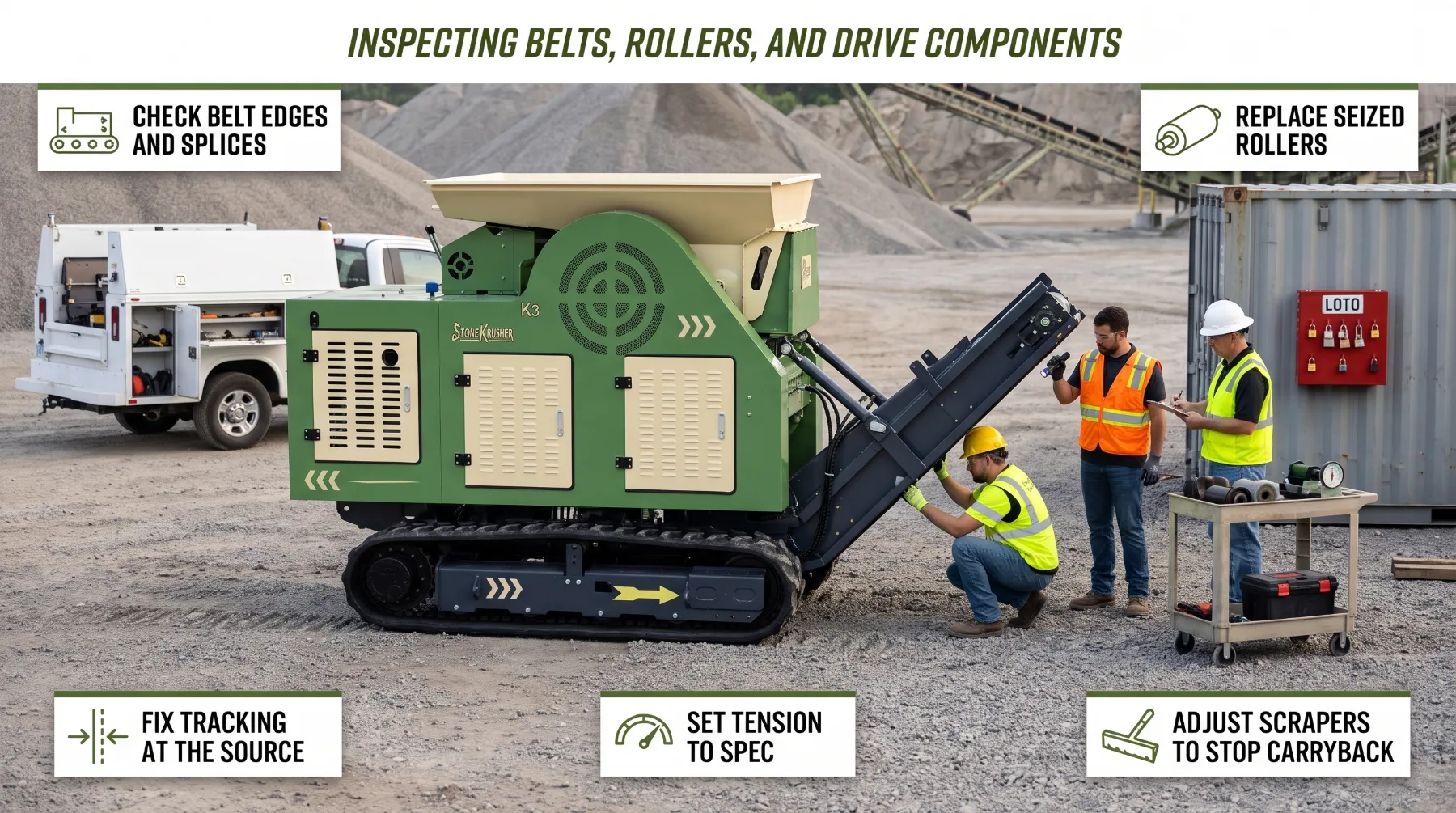
Regular inspection catches conveyor problems while they're still small and inexpensive. A frayed belt edge, a seized roller, or a worn scraper rarely stops production on its own. Left alone, each one leads to larger damage. Build conveyor checks into every pre-shift inspection, and complete them with the plant shut down and isolated.
Start with the belt. Look for cuts, gouges, torn edges, worn top covers, exposed carcass, and damaged splices or fasteners. Check tracking along the full length. A belt that runs to one side rubs the structure, frays its edges, and spills material. Mistracking often points to a seized or misaligned idler, off-center loading, buildup on pulleys, or uneven tension. Correct the cause rather than repeatedly adjusting one tracking point.
Rollers and idlers need close attention. A seized roller doesn't turn, so the belt drags across it. That wears the belt and can wear through the roller shell, leaving sharp edges that cut the belt further. Listen for squealing or grinding bearings and look for rollers packed with fines. Check impact idlers or impact beds at the loading zone, since falling rock damages them quickly. Inspect return rollers beneath the belt, where carryback often builds up unseen.
Drive and support components complete the check:
Pulleys: Look for worn or missing lagging on the head pulley and buildup on the tail pulley.
Tension: Check belt tension and take-up position against the manufacturer's guidance. Low tension causes slip, especially with wet material.
Drive: Inspect the hydraulic drive motor or electric motor, gearbox, couplings, and mounting for leaks, noise, heat, and loose fasteners.
Scrapers: Check belt scrapers for wear and correct adjustment, since worn scrapers let carryback fall and build up beneath the conveyor.
Structure: Check frames, folding hinges, and support legs for cracks, bent members, and missing fasteners.
Keep the conveyor free from accumulated material, and replace worn components before they cause wider damage or unplanned downtime. Record findings in a maintenance log so recurring problems, such as one roller position that keeps failing, become visible over time.
Key takeaway: Inspect belts, rollers, pulleys, scrapers, drives, and structure with the plant isolated, correct the root cause of tracking problems, and replace worn parts before they damage the belt or stop production.
Maintaining Consistent Material Flow
A crusher and its conveyors work best as a coordinated system with a steady, controlled feed. Surging feed from the hopper produces surging loads on the belt. Heavy surges spill material at transfer points, strain the drive, and can cause belt slip. Long empty periods waste capacity and increase wear without producing tonnage. A consistent feed rate, set to the crusher's real processing capacity, keeps the conveyor loaded evenly.
Transfer points are where most flow problems start. Wet fines and clay stick to chutes and build up until they restrict flow. Material that lands off center on a belt pushes it out of line, causing spillage along the edge. Watch the loading zone beneath the crusher and every point where one belt feeds another. Look for buildup, off-center loading, and material escaping past the skirting.
The receiving area deserves equal attention. A stockpile that grows up to the head pulley is one of the most common causes of backup on mobile crushing sites. Once material has nowhere to go, it spills back along the belt and into the crusher. Plan stockpile layout before production starts, and schedule loader work so piles stay well clear of the discharge.
Interlocks and start-up sequences protect flow across the plant. Many plants are wired so that if a downstream conveyor stops, the feeder stops automatically. That prevents material from piling onto a stalled belt. Start-up typically runs from the last downstream conveyor back toward the feeder, and shutdown runs in reverse so belts clear before stopping. Keep these interlocks working, and never bypass them to keep production moving.
Key takeaway: Feed the crusher at a steady rate, keep loading and transfer points clean and centered, move stockpiles before they reach the discharge, and keep conveyor interlocks and start-up sequences in working order.
Following Conveyor Safety Procedures
Conveyor systems contain moving belts, rollers, pulleys, and drive components that can cause serious injuries in an instant. The most dangerous areas are nip points, where a belt wraps around a pulley or runs onto a roller. A glove, sleeve, or hand caught there can be pulled in before anyone can react. Many serious conveyor injuries happen during cleaning, clearing spillage, or adjusting tracking while the belt is running.
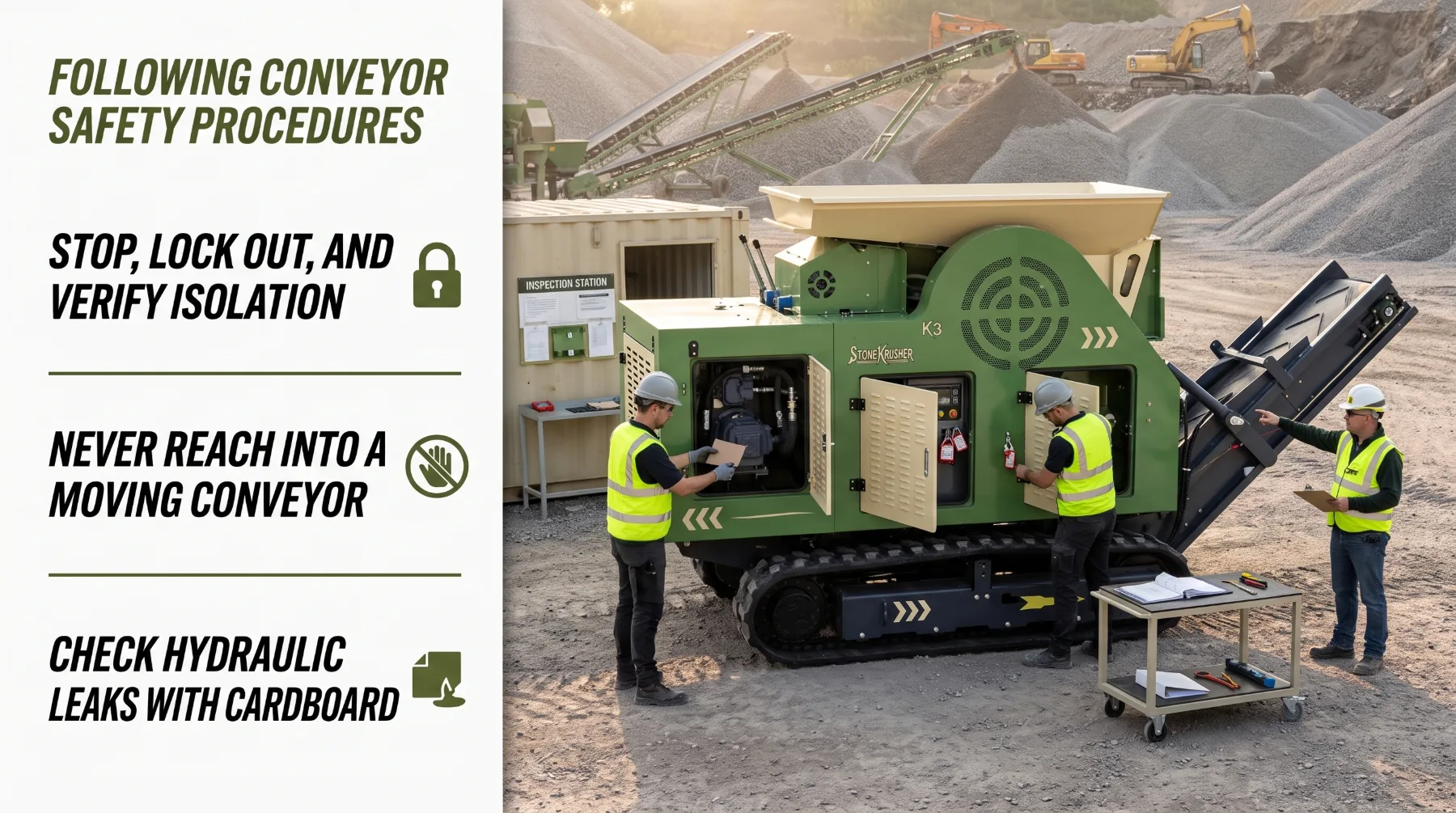
Keep every guard and protective cover in place during operation. Head pulleys, tail pulleys, drive components, take-ups, and return rollers within reach should all be guarded. Confirm that pull-cord emergency stops and stop buttons work along accessible lengths of the conveyor, and test them as part of the pre-shift check. Wear snug-fitting clothing with no loose ends, along with hi-vis, a hard hat, safety glasses, gloves, hearing protection, and respiratory protection where silica dust is present.
Hydraulic systems need particular care. Many mobile conveyors use hydraulic motors for drive and hydraulic cylinders for folding and raising. Inspect hoses, fittings, and cylinders for leaks and abrasion, but never use your hand to search for a hydraulic leak. Fluid escaping under pressure can penetrate skin and cause an injection injury that requires immediate emergency medical treatment, even when the wound looks minor. Use a piece of cardboard or wood, and wear gloves and eye protection.
Folding and setup add their own hazards. Never stand beneath a conveyor while it's being raised, lowered, or folded, and support raised sections with the manufacturer's approved devices before working below them. Keep people out of the stockpile area while the plant is running, since loaders, falling material, and unstable pile faces all create risk. Brief every crew member on lockout before they work near the plant.
Key takeaway: Keep guards and emergency stops working, never reach into or near moving equipment, fully stop, lock out, and release stored energy before any conveyor task, and check hydraulic leaks with cardboard rather than your hands.
Conclusion
A stone crusher conveyor system decides how efficiently crushed material leaves the machine and reaches the next stage. The discharge conveyor must match the crusher's output and the capacity of downstream equipment. Belt width must contain both the tonnage and the largest pieces in the product. Conveyor length and discharge height shape stockpile capacity, while steady feeding, clean transfer points, and well-managed stockpiles keep material moving. Regular inspection of belts, rollers, pulleys, scrapers, and drives prevents small faults from becoming costly breakdowns. Strict guarding, lockout, and safe working habits protect every person who works near the plant.
Frequently Asked Questions
What does a stone crusher discharge conveyor do?
It carries crushed material away from the crushing chamber to a stockpile, screen, secondary crusher, or truck. By removing product as fast as the crusher produces it, the conveyor prevents material from building up beneath the machine and backing into the chamber. On many mobile plants, a separate side conveyor handles pre-screened fines, and an overband magnet above the main belt removes tramp steel.
Does a wider conveyor always increase crusher output?
No. Output depends on the complete crushing and material handling system, including feed rate, crusher capacity and settings, downstream screens, and stockpile space. A wider belt can carry more material and contain larger pieces with less spillage, but it can't raise the crusher's processing capacity. Match belt width to the crusher's real output and the largest pieces in the product.
Why is conveyor discharge height important?
Discharge height determines how tall a stockpile can grow and how far material can be placed from the machine. For a cone-shaped pile, volume rises sharply with height, so a higher discharge can hold much more material before a loader needs to move it. Taller drops can also increase segregation and dust, so balance height against product consistency and site conditions.
How often should a crusher conveyor be inspected?
Follow the manufacturer's inspection schedule, and complete a visual check before every shift with the plant shut down and isolated. Inspect the belt, splices, tracking, rollers, idlers, pulleys, lagging, scrapers, tension, drive components, guards, and emergency stops. Increase inspection frequency in wet, sticky, or highly abrasive material, and record findings to spot recurring problems early.